
Durham Museum Weddings: Tips for Couples from a DJ
Couples fall for the Great Hall the second they walk in. The 65-foot ceilings, the Art Deco arches, the old Union Station grandeur. And almost everyone's first instinct is to picture the dance floor right there in the middle of it.
That's the one move I'll talk you out of.
The Durham Museum is one of Omaha's true showstoppers. Incredible venue. You couldn’t recreate that history and elegance if you wanted to.
But it's also a genuinely tricky room to run, the kind that takes three separate sound setups for a full wedding day. So before your wedding, let me save you the mistakes I've watched sink the energy at otherwise gorgeous weddings.
Hi, my name is Brent, and I founded Alternative Wedding DJs in 2016. I’ve personally DJ’d 100+ weddings and have planned and organized thousands of events throughout my career as an event promoter and the owner of House of Loom nightclub. I've obsessively studied the group psychology behind a great party, why people run to or away from a dance floor, and how a room's size and layout can help or hurt the experience.
We've DJ'd the Durham many times, from wedding ceremonies and receptions to corporate parties like Berkshire Hathaway's holiday event. And we have notes!
So we’re gonna take that insight and deliver it to you on a waterslide of your dreams, so you can skip the rookie mistakes and get the best night, with the least stress, out of your venue. Here we go …
The rooms and the three setups
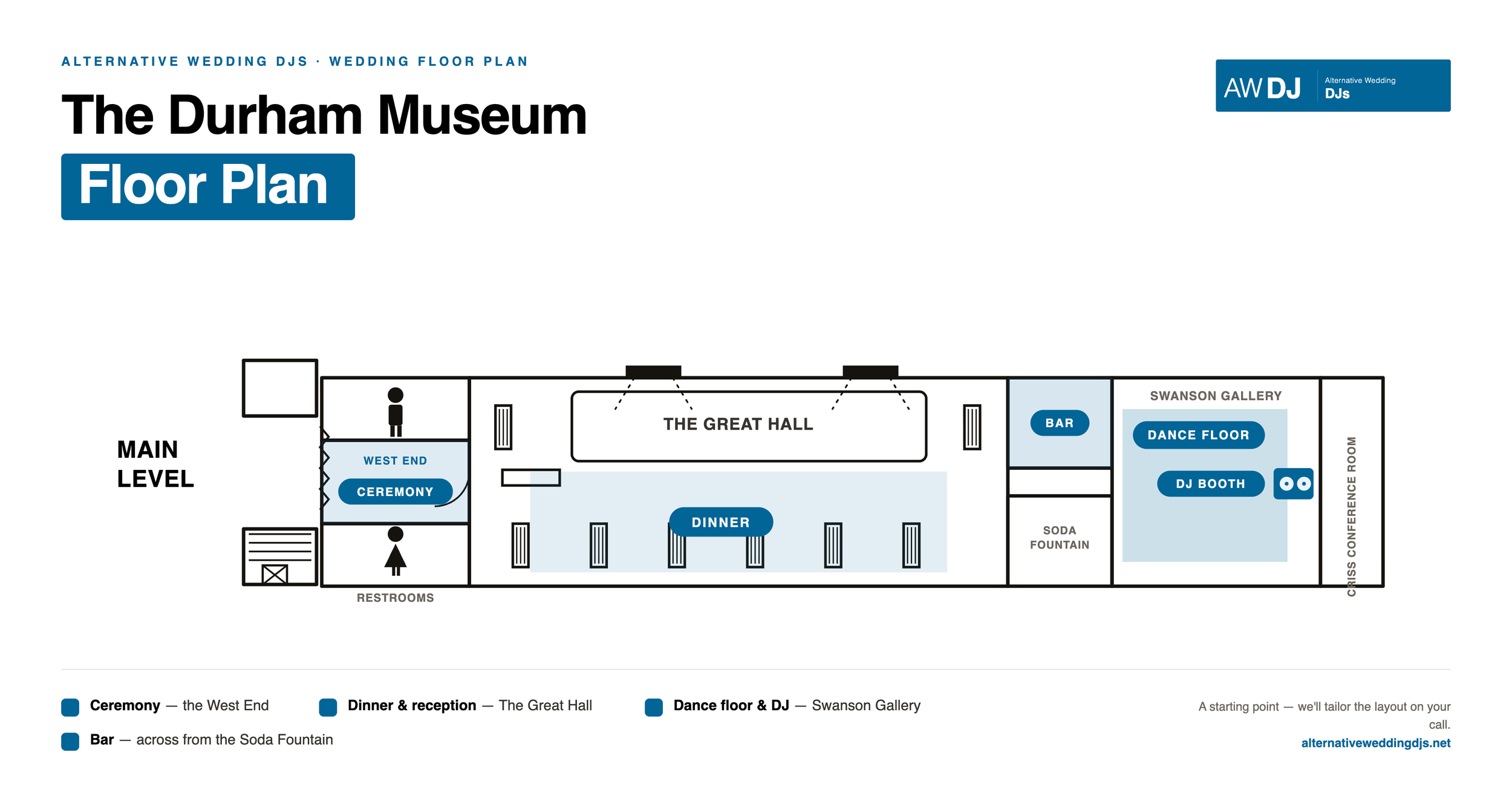
A full Durham wedding usually lives within 3-4 spaces, and each one needs its own sound system.
The West End, on the western side of the building, is where ceremonies happen. Under the soaring cielings, the Suzanne and Walter Scott Great Hall is where dinner typically happens (if you have a larger guest count). The Davidson Gallery in the basement is where cocktail hour typically happens. And the Swanson Gallery, the old Hayden House Restaurant space, is the second option for dinner. But for sure the reception and dancing take place there. For dinner there's a space just past the gift shop where in-house equipment sits that your DJ can plug into for background music and mic announcements, so that's setup number two. The dance floor in the Swanson is setup number three, on our own rig.
Three rooms, three systems, one timeline. This is why I'd point you toward an experienced DJ here. It's a lot of logistics to keep seamless, and the day falls apart in the gaps if whoever you hire is figuring it out as they go.
The Great Hall sounds as big as it looks
Here's the honest tradeoff. The Great Hall is a 10 out of 10 to look at and about a 3 out of 10 for sound. Those 65-foot ceilings and hard surfaces everywhere mean sound bounces around and seems to disappear into the room. It's beautiful, and it fights you acoustically.
If your guests hush, they can hear what's being said just fine. But the second you've got mingling and a microphone announcement happening at the same time, it gets difficult fast. So go in with reasonable expectations for the Great Hall: it's a stunning room to eat dinner in, not a room that's kind to a microphone. Plan the loud, important moments accordingly.
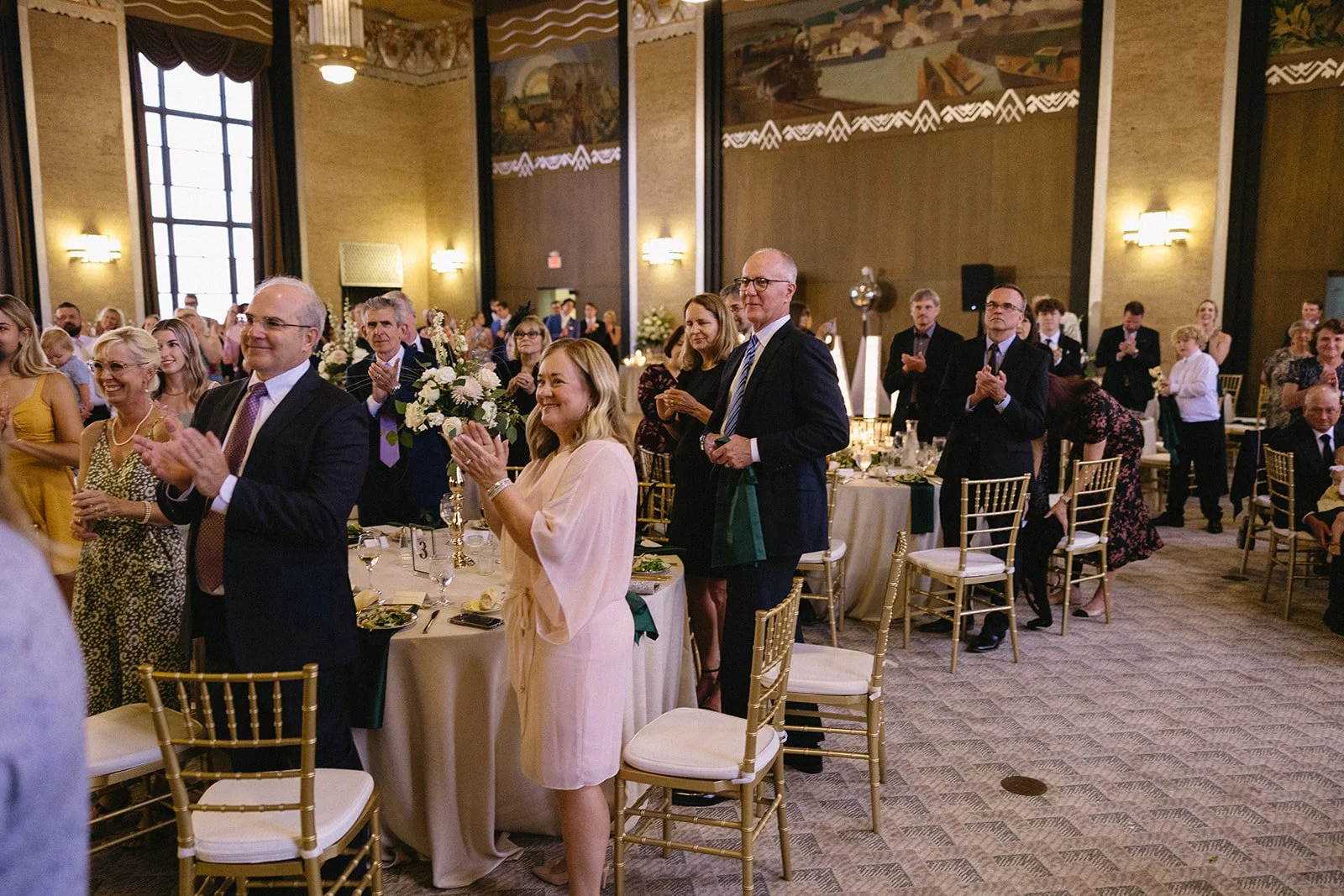
Having said that, we’ve also seen dinner and dancing inside the Swanson Gallery, and I’d ultimately recommend that, as you can see in this photo by MacKenzie Hope (here’s where she does a breakdown of this wedding).
Where the DJ booth goes
For the reception in the Swanson Gallery, we set up on the east center wall. That's the anchor for the night.
For the ceremony on the West End, it's a tight little corridor and a tough call. We’ve tried multiple set-ups, and here’s what we’ve found out …
Option 1: Not recommended — Set up in the front where the ceremony takes place.
Intuitively, you would think this is the logical place to go. But it’s crammed up there, so the DJ sets up in the little library nook. The problem is that then they can’t see what’s happening around the corner. And they can’t fully gauge how well the sound is being projected. So they’re reliant on the wedding planner to text cues and feedback. Some wedding planners are up for that, some may be too focused on the other details. So my preferred option is …
Option 2: What I recommend — Set up behind the audience, around the corner, off to the left (when facing into the room).
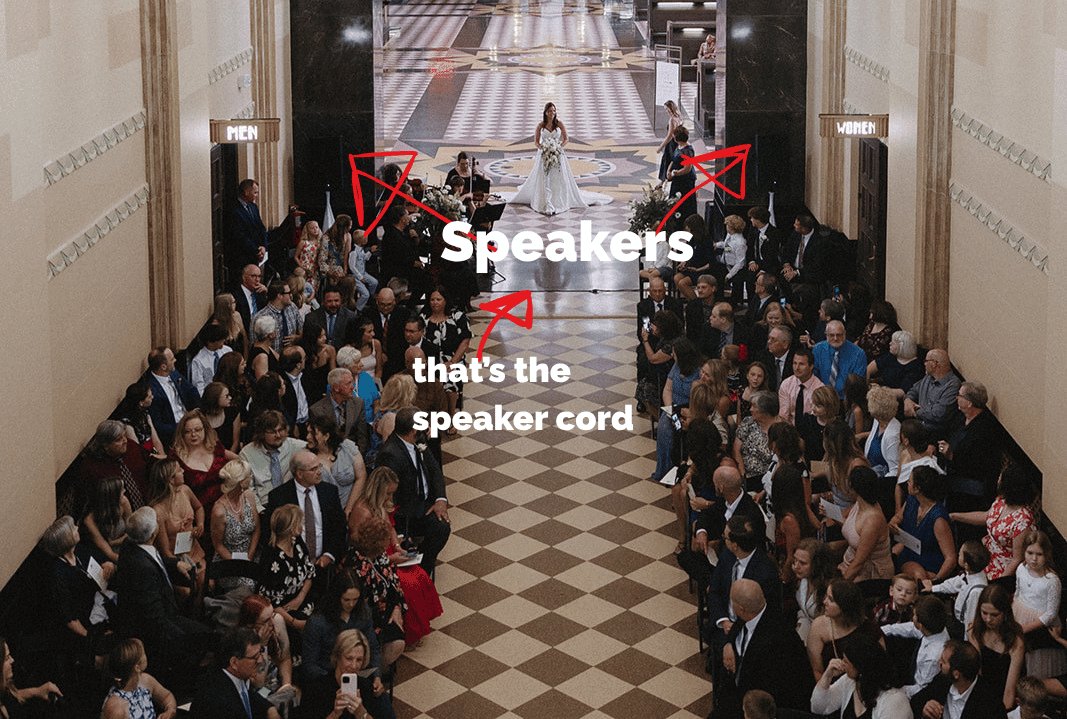
There’s power behind you on one of the seating structures. You can see everything that’s happening (so you’re not distracting the planner). And your gear isn’t in the photos. We run speakers on either side of the room in a nice corner (seen in the photo) to get an even spread.
That’s great for sound, but here’s what I don’t like: it means laying a speaker cord across the walking aisle (as you can see in the photo below). We take extra precautions and cover it with carpet or extra tape. And stand by the cord to point it out to people as they walk by. But it’s not ideal. And you can imagine a bride forgetting in the moment on those heels.
Alternatives: pay a bit extra and rent wireless speakers, or bunch the speakers together on one side of the room. Bunching increases the chance of mic feedback (if the officiant and bride/groom aren’t projecting their voice well), so you’ll have to weigh your priorities.
If you want to understand why we sweat the ceremony sound this much, here's the wedding detail nobody notices until it's missing.
Why the dance floor goes in the Swanson Gallery, not the Great Hall
My recommendation here is 100 percent, no hedging: do not put your dance floor in the Great Hall. It won't sound great, it'll give your guests ear fatigue, and power is sparse in that area on top of it. The Swanson Gallery is the way to go, every time.
To get people out of the Great Hall after dinner and into the Swanson, we run the first dance and the spotlight dances in the Swanson. People follow the couple, and the party starts where you want it. The Durham keeps tables and chairs in the Great Hall too, which is a nice touch, because it gives anyone who wants to sit and talk a place to land without leaving the party entirely.
The Swanson is also a room where renting uplighting earns its keep. The Durham doesn't have many lighting options in house, and it's a big room with dramatic columns, so uplighting has a real visual payoff in there.
The bar problem, and how we beat it
The bar is not inside the Swanson Gallery. It sits directly outside, next to the soda fountain. This isn’t uncommon for wedding venues, but it does make it more difficult for the DJ to keep people in the room. At some point, just about every guest leaves the dance floor to grab a drink, and it's easy for them to get stuck out there chatting. Two ways to handle it.
Option 1: Move the bar inside the Swanson Gallery
If the venue will let you, request that the bar be set up inside the Swanson Gallery. Keeping the drinks and the dancing in one room consolidates the crowd, and a consolidated crowd feels higher energy than the same people spread thin across two spaces. It's the same logic in our guide to setting up a reception so people actually dance: put everything in one place and you get more energy.
Option 2: The DJ just works a little harder
If the bar has to stay put, no problem. This is what we’re here for. We lean into it by playing more of the obvious, can't-sit-down wedding hits. You can watch the cascade happen: someone out by the bar hears the song they've been waiting for and comes jogging back into the room, and they pull others with them. Recognizable hits work better in this venue, because the song has to carry into the next room.
Insider info
A few logistics that make the day smoother:
Load-in is easiest from the far corner of the upper parking lot. There's a side entrance the caterers also use that gives you direct access to the Swanson Gallery, which is exactly where the booth needs to be.
Power is sparse in the Great Hall, which is one more reason the dance floor doesn't belong there.
When doing cocktail hour in the lower-level Davidson Gallery, the DJ needs to bring a speaker for music. The Durham used to have stereo equipment down there you could plug into with an RCA cable, but as of a December 2025 corporate event we ran, that option was no longer available.
It’s an active museum, and parts of it can be open to the public during setup or cocktail hour, so build that into your timeline.
If your count is bigger, or you want more of the building
The Durham scales. The Swanson Gallery seats up to 250 for dinner, the lower-level Davidson Gallery among the trains and permanent exhibits holds around 150 and makes a popular cocktail-hour space, and the West End handles a ceremony of up to 175. You can rent individual galleries or the whole building, and you book directly through the Durham's rental team.
FAQ
Where should the dance floor go at the Durham Museum? The Swanson Gallery, not the Great Hall. The Great Hall's 65-foot ceilings and hard surfaces make for rough acoustics and ear fatigue, and power is limited there. We stage the first dance and spotlight dances in the Swanson to draw guests in from dinner, and the party stays there.
Can guests hear the toasts in the Great Hall? If the room is quiet, yes. The challenge is when guests are mingling and someone's on the microphone at the same time, because the Great Hall's scale scatters the sound. We plan the timing of announcements and toasts around that, and set expectations that the Great Hall is a showpiece for dinner more than a room built for amplified speech.
Can you have your wedding ceremony at the Durham Museum? Yes. Ceremonies happen in the West End, which seats up to 175. We set the booth to the side of the entrance to stay out of your photos and run speakers on both sides for even sound, taping down any cord that crosses the aisle so it's safe.
Can you play music in more than one room at the Durham? Yes, and a full wedding here usually runs three sound setups across the ceremony, dinner, and dance spaces, which is why we recommend an experienced DJ for this venue. If you also want music in the lower level, plan for your DJ to bring a separate system, since the venue's old plug-in option wasn't available as of late 2025.
Getting married at the Durham Museum?
It's one of Omaha's true showstoppers, and it rewards a DJ who knows its quirks: the three setups, the Great Hall's acoustics, and the one rule that makes or breaks the party, which is to dance in the Swanson. We know this building. Book a meeting with us and we'll map out your night room by room. See the rest of our Omaha and Lincoln team, or read our guide to weddings at the Kimpton Cottonwood for another iconic Omaha room.
Photography by Sarah McKenzie Photography.
— Brent Crampton, Company Founder
