
How to Get People Dancing at Your Wedding: 7 DJ Tips
The potential for dancing at your wedding gets a grade before your DJ plays a single song.
The venue you pick and how you arrange the room either adds or reduces friction to how comfortable your guests feel about dancing. So if you're wondering how to get people to dance at your wedding, most of the answer is decided in the room setup, before the first song plays.
Most wedding planners don't know this. We do, because our crew at Alternative Wedding DJs has DJ'd thousands of weddings, private events, bars, and clubs across hundreds of venues in Omaha, Lincoln, Madison, and Milwaukee. We've watched the same seven things separate the packed floors from the polite ones, and they work in any room, in any city.
The short version:
Put the bar next to the dance floor
Book a smaller room
Clap-test the acoustics
Find a wood floor
Kill the lights
Lose the dinner seating
And let your DJ trick everyone into a group photo.
The details on each below.
Marry the bar and dance floor
Put the bar in the same room as the dance floor, as close together as the space allows. Space can be limited in wedding venues, so it's common to place the bar in one room and the dance floor in another. That's a mistake. People will always congregate where food and drink are. Not necessarily the dance floor. Put them together and you never give your guests an excuse to leave the party.
Two rooms we play in Omaha that nail this: Bohemian Gardens, where the dance floor sits on the same deck as the bar, and the Empire Room, where the bar and floor share one space. Whatever city you're in, tour venues with one question in mind: can I see the bar from the dance floor?
ACTION: Ask us for input on the floor plan, and always put the bar & dance floor as close together as possible.
Cozy rooms make crazy parties
Book a room that runs slightly small for your guest count. We call it room psychology. When you have 100 guests in a big room, it feels empty and (worst-case scenario) awkward. Take that same crowd and put them into a slightly-too-small room, and ... BAM! Social interactions increase, the potential for dancing increases, and the overall energy goes up.
ACTION: Go for smaller venues or room arrangements that create tighter spaces.
For sound quality, clap test it
Stand in the middle of the room, clap your hands once, and listen. If you hear an echo, the room is full of reflective surfaces like concrete, metal, and bare walls. Avoid if possible.
Ideally, you want a room with materials like wood, drapery, or paneling. This absorbs sound and makes a world of difference in audio quality while reducing ear fatigue (which subconsciously gives people the urge to leave the room).
We don't wanna rat out any venues publicly, so message us, and we'll give our honest feedback. :)
ACTION: Do the clap test, and if it echoes, either switch venues or look for ways to add sound-absorbing materials.
Adore the wood floor
Pick a venue with a wood floor, or bring one in. Along with helping the room sound better, wood floors are also friends to your feet. That's because wood has a slight bounce, whereas concrete wears on you. One thing we learned from booking club events for salsa dancers: it's wood floors or bust.
The Riviera Ballroom in Lake Geneva comes with a built-in wood dance floor, which is one reason we love playing it. And the Mirror Room at Le Bouillon in Omaha has a 100-year-old floor that's seen more parties than Charli XCX.
ACTION: Pick a venue with wood floors or bring in a makeshift wood dance floor.
Make the lights go low
Drop the lights the moment the dance floor opens. The whole goal is to reduce inhibition. Alcohol does that. So does darkness. When people feel less like they're being watched, they're given more license to be in the moment.
ACTION: Give ownership of this to your DJ, and they’ll discuss lighting transitions with the venue.
Gotta get up to get down
Swap dinner seating for cocktail tables before the dancing starts. When you're sitting down with your knees under a table, it takes more effort to stand up, and that effort keeps some guests from ever making the trip to the floor. We learned this from reading how the old NYC disco clubs did it.
Bar stools are slightly better. Cocktail tables are preferred, as they act as anchors that draw people in and give them a spot to place their drinks. We've seen plenty of broken glass hit a dance floor before, and we've swept it up ourselves.
ACTION: If possible, don’t use dinner tables during the dance party and place cocktail tables without seating in and around the dancefloor to act as an anchor to draw people in.
Trick them onto the dancefloor
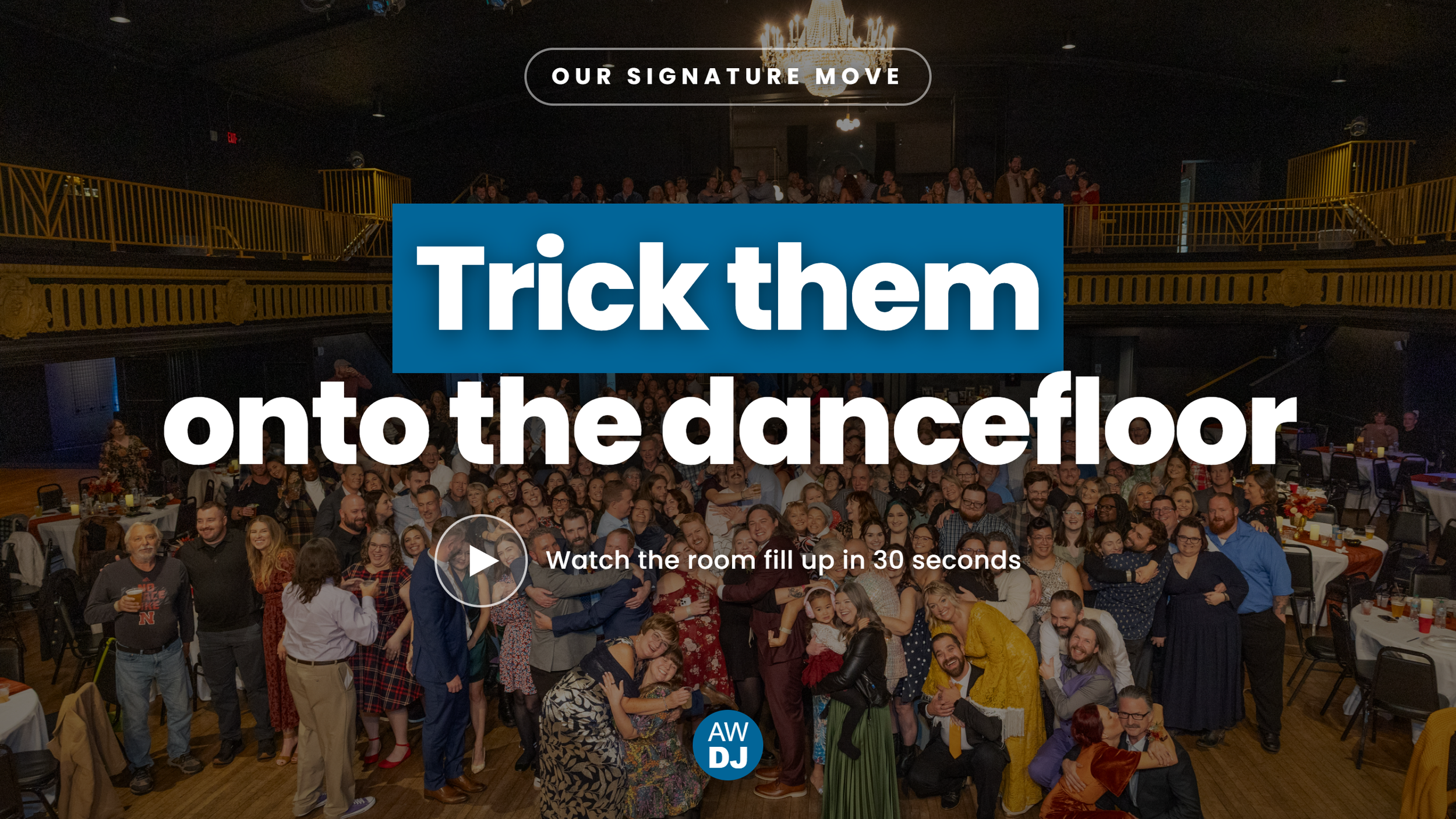
Our signature move: when you're ready for guests to flood the dance floor, the biggest hurdle is getting them to pay it a visit. So we "trick" them into gathering for a group photo on the floor. Everyone smiles, then does something silly, then throws their hands in the air as the music goes up and the lights go down. Nobody has anywhere to walk back to. The party has started.
For evidence, see the video below.
ACTION: Let us know you’d like to do this and we’ll coordinate with the photographer.
Dance floor questions we hear a lot
Why don't people dance at weddings? It's usually the room, not the crowd. The four most common killers: the bar in a different room, bright lights, a floor too big for the guest count, and guests planted behind dinner tables. Fix those and most crowds will dance.
How do you get guests on the dance floor without cheesy games? Use the group photo trick above. Gather everyone on the floor for a photo, then bring the music up as the lights go down. No Cha Cha Slide, no forced participation, and the floor is already full.
Does dance floor size matter? Yes, and smaller wins. A floor that runs slightly tight for your guest count looks and feels full, which pulls more people in. An oversized floor reads as empty even when 30 people are dancing.
When should dancing start at a reception? Right after the formal dances, while every guest is still in the room and paying attention. Momentum is easier to keep than to rebuild. Our Case for a 5-Hour Reception breaks down the full timeline.
We can be the DJ at your event
Planning a wedding in Omaha or Lincoln or Madison or Milwaukee? This is the kind of stuff we handle for you.
Getting married somewhere else? Steal all seven steps. They work in any room. And if you want a second opinion on your floor plan, send it over. We like this stuff.