
Empire Room Weddings: Tips for Couples from a DJ
When a couple tells me their venue has a sound system we're welcome to use, I almost always say thanks, but I'll bring my own.
It's not snobbery. I tried it the other way early on, and it taught me a lesson: you show up and something's missing, or moved, or broken, and the one person who knows how to fix it isn't there. Bringing my own rig that I know works is the smoother path almost every time.
The Empire Room is my exception. My friend Dave Stutsman built the system in there, and it's genuinely helpful for a long, unusual room with layered sound logistics. It definitely needs an experienced DJ to make it work. So before your wedding day, here's how to get the most out of a room that has more going on than it looks.
Quick intro to establish why you should take my advice: I'm Brent, and I founded Alternative Wedding DJs in 2016. I've personally DJ'd 100-plus weddings and planned and organized thousands of events over my years as an event promoter and the owner of a nightclub named House of Loom. I've obsessively studied the group psychology behind a great party, why people run to or away from a dance floor, and how a room's size and layout can help or hurt the experience.
I've DJ'd the Empire Room half a dozen times, my DJ team: DJ Jak_E, DJ Crabrangucci, DJ Nick the Quick, DJ Ness and many more. And we have notes!
So we're gonna take that insight and deliver it to you on velvet curtains, so you can skip the rookie mistakes and get the best night, with the least stress, out of your venue. Here we go …
Where the DJ booth goes
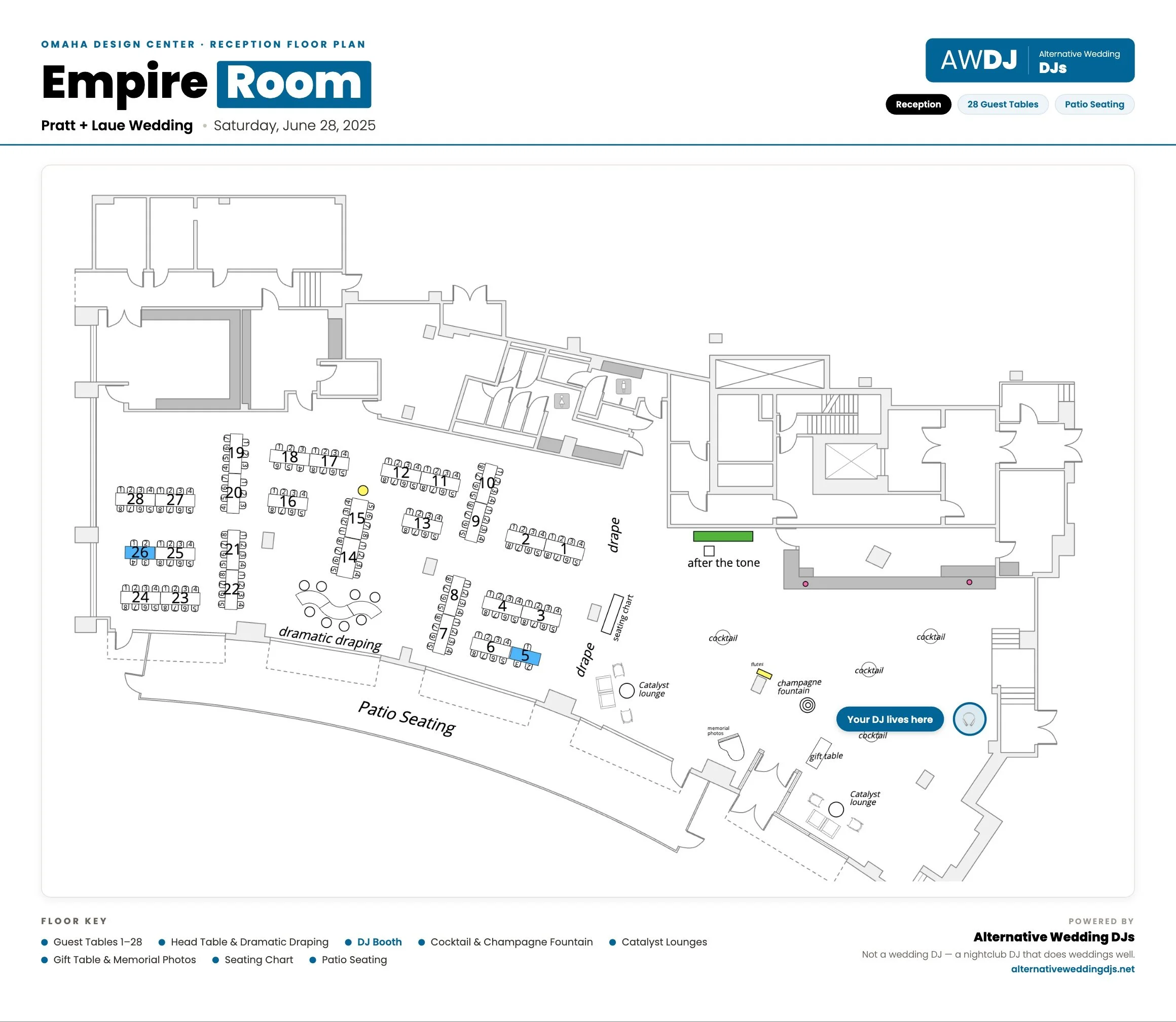
Northeast corner. There are power outlets right behind the booth, so setup is clean.
Here's what makes the room unusual: it runs as two spaces with two separate sound systems. The bar area, where cocktail hour and dancing happen, has speakers staggered through it so the sound spreads evenly instead of blasting from one spot. The dining room has its own system and an in-house wireless mic, which is what you want for dinner background music and for toasts and speeches.
We still bring our own speakers and a subwoofer for the dance floor anyway. The house system is good, but a sub adds the low end that makes a floor feel alive, and our own boxes give us complete control of the room when it counts.
We bring our own gear for another reason too, and that's backup. One wedding, I showed up and the receiver for the dining room's wireless mic was glitching. I got it working by bending the power cord just right and babying it through the toasts, but if it had quit on me, we'd have swapped in our own mic and nobody in the room would have known. That's the whole case for carrying your own rig even at a venue whose system you trust. You plan for the night the equipment decides not to cooperate.
Worth saying plainly: not every DJ on our team leans on the house system, and that's fine. Jackie brought her whole rig for a recent wedding here and ran the night entirely off her own gear, putting two speakers in the bar room and a third over on the dining side to cover it. Both approaches work in this room. What matters is that whoever you hire has walked it and made the call on purpose rather than finding out at 4pm.
One thing that argues for the house mic, though. On that same wedding Jackie's booth got relocated (a pianist had her corner), which left her a long way across the room from the head table. Her own wireless mic had to fight that distance plus drape and wall panels in between, and it cut in and out during the toasts. The couple were relaxed about it and simply stopped using it, but it's the clearest argument I know for two things: use the dining room's in-house wireless mic for speeches when you can, and tell your DJ where the head table is going before the day, because that's what decides whether the booth can cover it.
What about the ceremony
Every wedding I've personally played here has been a reception. Couples married somewhere else, usually a church, then came to the Empire Room for cocktail hour, dinner, and the party. This room is built to throw a reception, and that's what it's best at.
We've still never run the ceremony audio here ourselves. But Jackie recently worked a wedding where the couple married in this room and brought in a pianist to play it, and what happened to her setup is worth knowing before you plan the same thing.
The corner she was assigned got taken by the pianist and his piano. So she had to move her whole rig down to the first set of garage doors and rebuild her plan on the fly. Setup that normally runs an hour took her an hour and a half, and it put her booth a long way from where the head table sat for the rest of the night, which caused problems later (more on that below). Her honest summary of the configuration was "messy," and she'd steer a couple away from it.
So if you want both in this room, two things will save your day. Keep that front corner clear. If you're bringing live musicians, settle with the venue where they set up before the day, because if they land in the DJ's spot everything downstream gets harder. And tell your DJ where the head table is going, early — that's the piece of information that lets them place the booth once and not have to choose between the ceremony and the toasts.
Then there's the changeover. After the ceremony, staff need roughly 30 minutes to clear the chairs, and the draped side of the room isn't open yet. Guests will go looking for somewhere to be, and most of them drifted out onto the patio, which nobody was staffing at that moment. It worked out fine, but plan for it: decide in advance where your guests go during that half hour, and make sure someone owns that space.
How the night moves through the room
The Empire Room has a flow to it, and using it well is most of the job.
During cocktail hour, the DJ is in the bar area playing background music while guests filter in, grab a drink, and settle. When it's time for dinner, the staff close the curtains to the dining room and briefly shut the bar down, which is a gentle way of telling everyone to go find their seats. The DJ hops to the dining room, brings up dinner music, gets the wireless mic going, and announces the couple's grand entrance.
The smartest move comes after dinner. To pull people out of their chairs and back toward the party, we put the first dance over in the bar and dance floor area, not the dining room. People follow the couple, the floor has bodies on it before the open dancing even starts, and the night tips into party mode on its own.
One of the things I love about this venue: the bar is right where the dancefloor is at. It's the same principle we wrote about in how to set up a reception so people actually dance: put the bar where you want the crowd, and they'll go to it.
From there it runs itself. People dance, drift to the bar, come back. And anyone who wants a breather can sit in the dining room and have a real conversation without shouting over the music. Two rooms, two volumes, everybody happy.
Getting the levels right
This is the part that earns the "experienced DJ" caveat. When you use the in-house system, the levels take finessing. If the house mixer isn't turned up enough and the DJ pushes the output on our end, you can redline the house mixer and the sound goes muddy. So we set those levels before guests arrive, and then walk the room a few times at the peak of the night to make sure it's landing right everywhere, never too loud, but loud enough to feel like a celebration.
That matters more at a wedding than a club, because the room holds every generation at once. The goal is a floor that everyone wants to be on, which is also why the quiet dining room is a feature, not a flaw. People who tap out for twenty minutes have somewhere to go, and they come back.
Insider info
A couple of logistics that make the day easier:
Load-in is about as good as it gets downtown. There's a handicap ramp right out front, so you can pull up, throw your hazards on, roll the gear straight in, and go park after. No long haul from a back lot.
Power is handled at the booth. Outlets sit directly behind the northeast corner, so there's no running cords across the room.
If you're covering the far side of the room, bring extension cords. The booth corner is well served, but the outlets are on the sidewall and the far end by the bar. Jackie had to run an extension out of the bar area to power a third speaker on the dining side.
The night stops at 11pm, and vendors are out by midnight. Nobody framed it as a hard cutoff on the night, but that's the shape of it, so build your timeline to peak before 11 rather than hoping for extra time.
No certificate of insurance was asked for. We carry one anyway, but it's not a hurdle here.
The music that fits the room
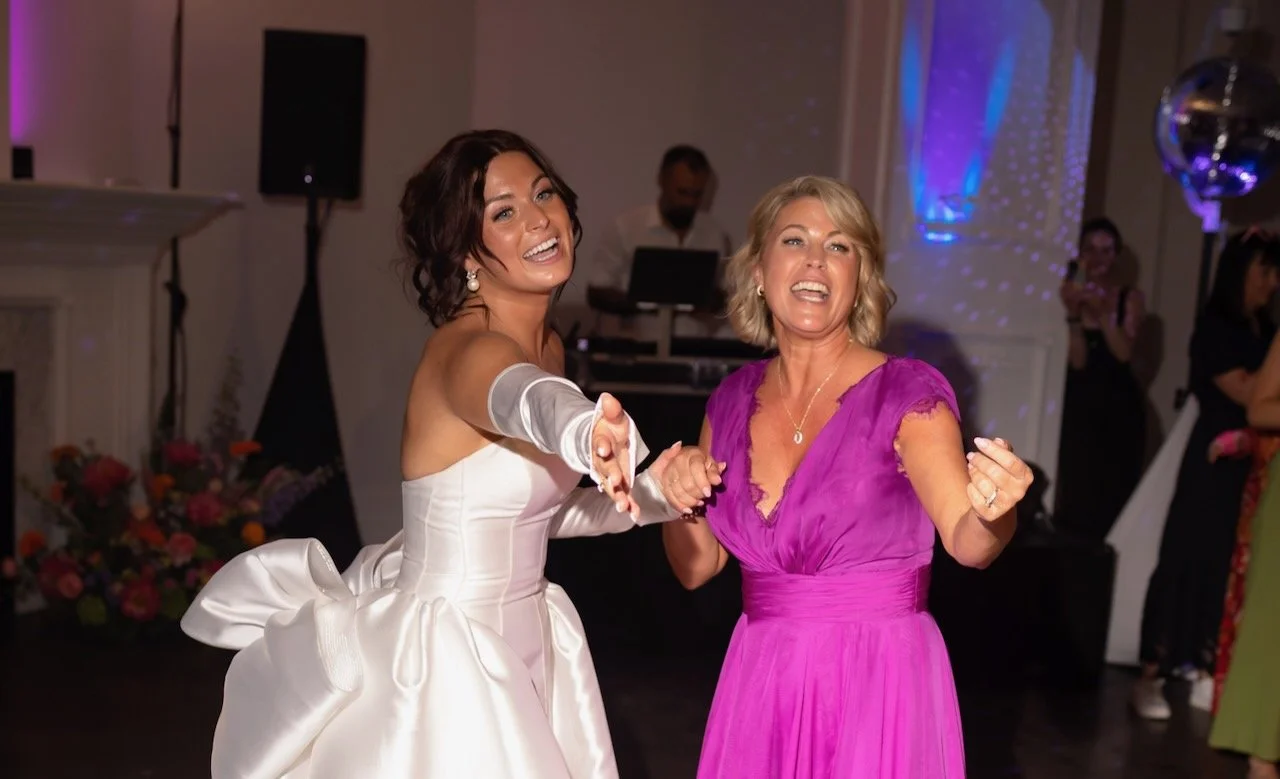
Photos by Sarah Frances Photography
The Empire Room pulls a crowd that came to celebrate, and the two-zone layout rewards a DJ who can read which room needs what. Dinner stays warm and easy, the bar room builds.
One wedding we played, it was obvious the room was there to dance from the first song. The mother requested a secret mix for the mother-daughter dance. The bride thought she was slow dancing to ABBA's "Slipping Through My Fingers.” Which she did. Until it was interrupted with one of those classic “record scratch” sounds (the mother’s request, and right into the middle of Lady Gaga's "Born This Way."
Everyone’s mouth dropped and then the mom called friends and family out to dance. It landed perfectly, and it’s my favorite moment from all the weddings I’ve done at Empire Room.
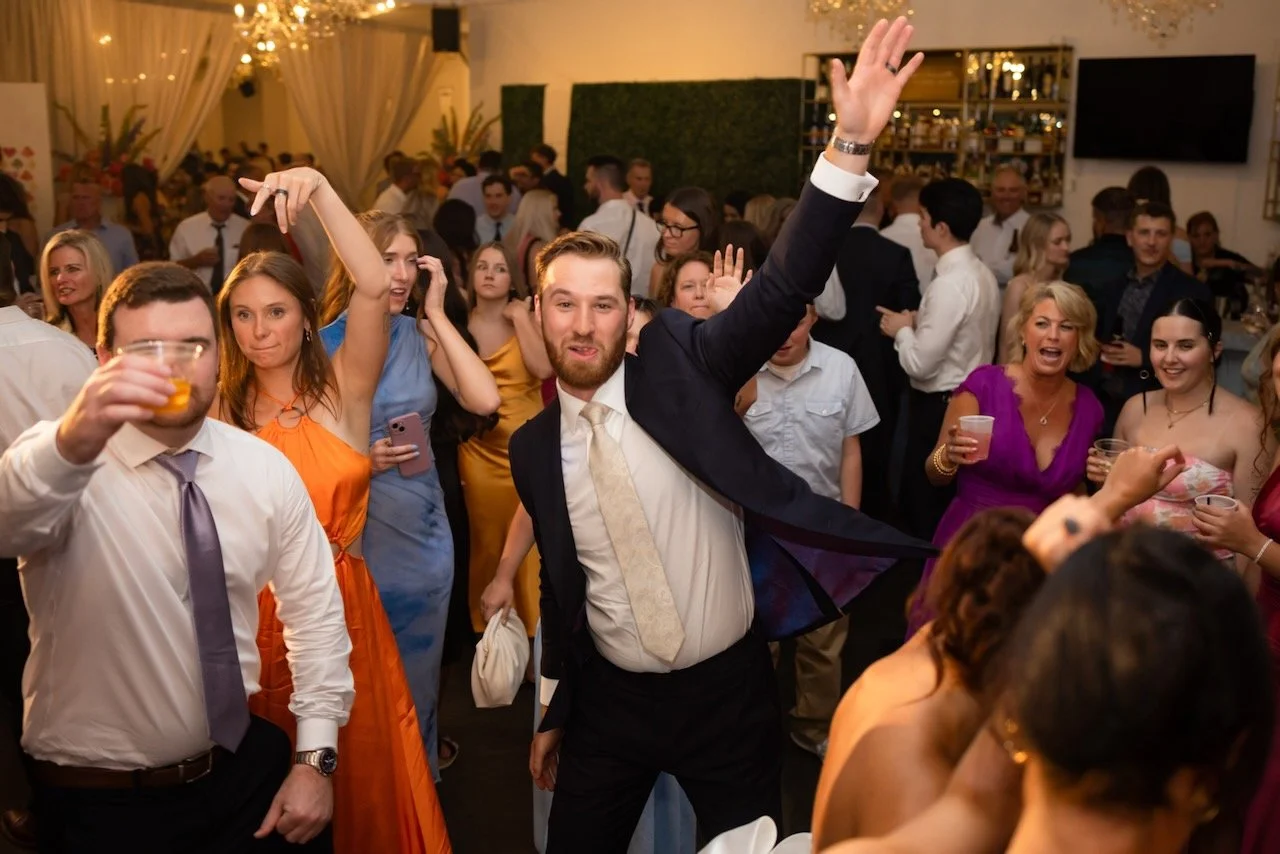
Funny enough, ABBA keeps doing the heavy lifting in this room. Jackie's most recent wedding here tipped the same way: the moment "Mamma Mia" came on, the whole room started singing it back at her. Something about the two-zone layout and a crowd that's already had a drink at the bar next to the floor.
If your count is bigger
The Empire Room is bigger than it first feels. It holds up to 300 seated and around 500 for a cocktail-style event, so it scales well past the reception size most of our couples run. There's also a spacious patio that looks out over Turner Park, which is a great spot for cocktail hour or a breather, plus a working fireplace and the chandeliers and antique furniture the room is known for. If you're thinking through how long to keep the night going across all that space, here's Our case for a five-hour reception.
FAQ
Can you use the Empire Room's in-house sound system?
Yes, and it's one of the few venue systems we actually recommend using. It was built well and runs as two zones, one for the bar and dance floor and one for the dining room, with an in-house wireless mic for toasts. We still bring our own speakers and a subwoofer for the dance floor to add low end and keep full control of the room.
Is the Empire Room one room or two?
It functions as two connected spaces: a bar and dance floor area where cocktail hour and dancing happen, and a separate dining room with its own sound. Curtains close off the dining room for dinner, and the layout lets guests dance in one space while others have a quieter conversation in the other.
Where does the dancing happen at the Empire Room?
In the bar area, not the dining room. We stage the first dance there on purpose, right after dinner, to draw guests out of their seats and into the party space. The bar sitting next to the dance floor keeps the energy and the drinks in the same place, which keeps the floor full.
How does load-in work for a DJ at the Empire Room?
It's easy. There's a handicap ramp directly out front, so a DJ can park out front briefly, roll equipment straight in, and park afterward. Power is at the northeast corner where the booth sets up.
Can we have our ceremony and reception both in the Empire Room? You can, and the venue has the grand staircase for it, but we'd steer you toward marrying elsewhere and using this room for the reception. At the one wedding where we worked a same-room ceremony, it got tight: live musicians took the DJ's corner, which pushed the booth far from the head table and made the wireless mic struggle during toasts. If you do want both, keep the front corner clear, tell your DJ where the head table is going, and plan where guests go during the 30-minute chair changeover.
What time does the music have to end at the Empire Room? Plan on the night ending at 11pm, with vendors out by midnight. We build the timeline so the peak of the dance floor lands before the cutoff instead of getting cut off mid-song.
Getting married at the Empire Room?
It's one of the few rooms in Omaha where we lean on the house system, because it's that good and because we know how to run it. We know the two-room flow, the booth corner, and how to keep both spaces sounding right all night. Book a meeting with us and we'll walk you through your night. See the rest of our Omaha and Lincoln team.
— Brent Crampton, Company Founder