
The Grain Exchange Weddings: Tips for Couples from a DJ
Walk into The Grain Exchange and the room does the talking before you say a word. It's the old trading hall inside downtown Milwaukee's Mackie Building, nearly 10,000 square feet under ceilings that climb something like forty feet, with hand-painted frescoes, gold leaf, and stone walls that have been there since the 1870s. It's grand in a way most Milwaukee venues can't touch.
That same grandeur is the thing you have to plan around. A tall room wrapped in stone and hard plaster is reflective, so sound leaves the speakers, hits all that hard surface, and comes back as a wash instead of a beat. Left alone, that's how a gorgeous room ends up with a soft dance floor. There's a fix, and it's most of what this guide is about.
Quick intro, since you're trusting us with advice: I'm Elliott Harris, co-owner of Alternative Wedding DJs and the person who runs our Wisconsin office. I started on radio straight out of high school, got my degree at the Conservatory of Recording Arts and Sciences in Arizona, and spent time at Can Am Studios in LA before family brought me back to the Midwest. Since then I've spent years booking and programming rooms for hospitality groups in Madison and Milwaukee, on top of the weddings. Between the club nights and the dance floors, I've learned why a room fills or empties, and how a space's size and layout shape the whole night.
Our Wisconsin team plays weddings across southern Wisconsin, the Milwaukee area included. And some on our team have played this room a few times.
So we're gonna take that insight and deliver it to you on a freight elevator packed with confetti, so you can skip the rookie mistakes and get the best night, with the least stress, out of your venue. Here we go…
Where the DJ booth goes
As a rule, the booth belongs at one end of the dance floor with the speakers firing across the crowd and down toward the floor, not up into that giant open ceiling. In a reflective room, every bit of sound you send at the walls or the glass comes back late and muddy, so we aim coverage low and keep the energy on the people. We also want the booth close enough to the floor that the DJ can read faces and adjust in real time, which is the whole job.
We're holding the exact booth diagram until we walk the room with you. Placement here depends on where dinner tables land, where the dance floor gets set, and how the balcony and the two connected spaces are used on your date, and we'd rather map it in person than guess.
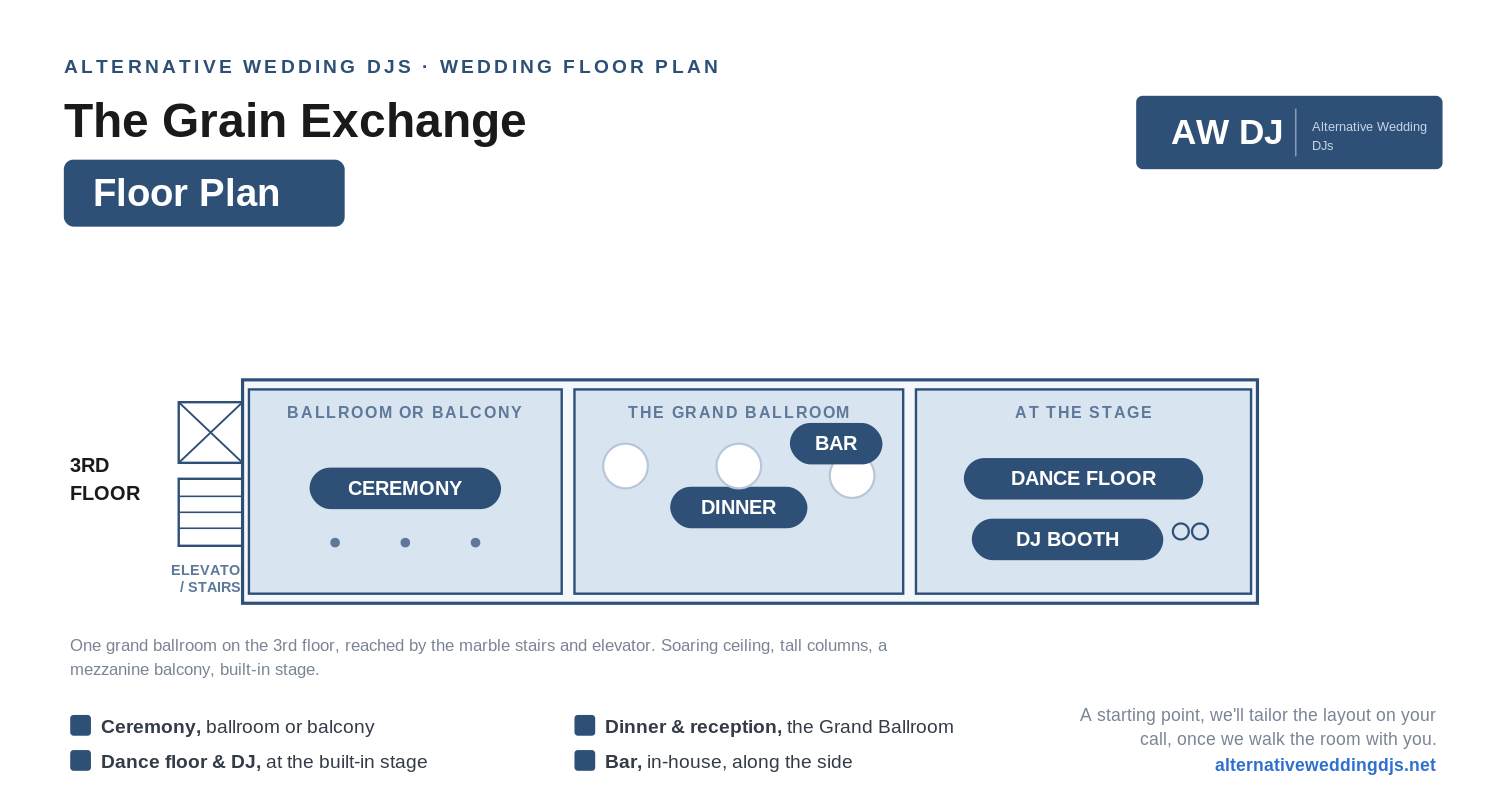
Dance floor strategy
A big beautiful room can swallow a party if the dance floor feels like an afterthought in the middle of all that space. The move is to make the floor feel like the center of gravity. We keep the booth and speakers anchored to it, we lean on lighting to draw a clear edge around it so people know where the party is, and we build the night so the floor fills early and stays full.
Sizing matters too. The room seats around 300 with a dance floor, and not everyone dances at once, so an oversized floor reads as empty even when plenty of people are up. We'd rather have a floor that looks packed than one that looks half-used, and we'll help you land on a size that fits your guest count.
How the room sounds
This is the part that decides your night. Tall ceilings and hard stone and plaster mean sound bounces a lot, and reflected sound arrives late and blurs the beat, which is what makes a reverberant room feel loud and mushy at the same time. The answer isn't more volume. More volume just feeds more reflection.
What we do instead is control where the sound goes. We aim speakers down and across the crowd so the direct sound reaches people before the reflections do, we place the system to keep energy off the tallest hard surfaces, and we tune levels for the guests on the floor rather than for the far corners of the hall. Bodies help too, a full room absorbs more than an empty one, so the space behaves better once your guests are in it. Done right, the floor gets a clean, punchy beat while the room keeps sounding like the room.
Insider info: load-in, power, parking
The Grain Exchange sits upstairs in a historic multi-story building, so load-in almost certainly runs through an elevator rather than a quick door-to-floor roll. That changes our timing, and it's worth knowing for every vendor you hire. We confirm the load-in route, the elevator, and any time windows with the venue ahead of the date.
On power, we plan our own clean, self-contained power setup and we like to confirm circuit locations near the booth so nothing shares a line with something that'll trip it.
Parking is downtown parking. The building itself is short on dedicated spaces, so most guests will use nearby garages, lots, or street parking. It's worth putting a parking note on your website or invites so nobody's circling blocks in the cold in January.
Cocktail hour
The Grain Exchange has more than one space to work with, including a balcony, and couples often run cocktails in a separate area from the main dining and dance setup. That split is useful. It gives guests somewhere to land while the main room gets finished or flipped, and it sets the tone before the party starts.
For us, cocktail hour is a lighter, lower-volume bed of music in that space so people can talk, while we're setting and checking the main system next door. If cocktails and dancing end up sharing a space, we plan the sound so the cocktail feel doesn't bleed into a room that isn't ready yet.
The music that fits the room
A room this grand can carry a wide range, and the goal is a night that feels like yours. We build the arc across the evening, dinner sits warmer and lower so people can talk under it, then the energy climbs into the dance set once the floor opens. In a reflective hall, cleaner, punchier tracks tend to read better on the floor than dense, boomy ones, because the room is already adding its own wash, so we lean into music that keeps a clear beat.
We'll get your must-plays, your do-not-plays, and the feel you want, and we program from there. You don't need a finished list to start. That's a conversation.
If your guest count is bigger
The room stretches to around 500 for a cocktail-style reception and about 300 seated with a dance floor, so it can go big. As the count climbs, two things get more important. First, coverage: a larger crowd spread across a tall room needs a speaker plan that reaches the back without blasting the front, which usually means adding a support speaker rather than just turning up the mains. Second, flow: more people means more pressure on the load-in, the flip, and the path between dinner and the dance floor, so we tighten the timeline with you and the venue. Bigger works well here. It just wants a plan.
FAQ
Is The Grain Exchange too echoey for a good dance party?
No, not with a system that's set up for it. The room is reflective because it's tall and hard-surfaced, but that's a coverage-and-placement problem, not a dealbreaker. We aim sound down and across the floor and tune for the crowd, and a full room absorbs a lot of that reflection on its own.
What should we tell guests about parking?
Tell them ahead of time. Downtown Milwaukee parking means garages, lots, and street spots rather than a big dedicated venue lot, so a short parking note on your website or invite saves everyone the January hassle.
How early do you arrive to set up?
Enough ahead that we're fully set, sound-checked, and out of your photos before guests arrive. In an upstairs historic building with elevator load-in, we build in extra time, and we coordinate our arrival window with the venue and your other vendors so load-in doesn't collide.
Getting married at The Grain Exchange?
If you're planning a wedding at The Grain Exchange, we'd love to help you get the room sounding as good as it looks. Reach out here and let's talk about your date.
