The case for a 5-hour reception
Here’s our time-tested advice for how to time your wedding reception to maximize the fun. You’ll get a fill-in-the-blank timeline and our best insight into how we’ve seen weddings in Omaha and Lincoln go.
I have DJed at over 100+ weddings. If you wanna avoid guest fatigue, read this to gain invaluable insights on how to time your wedding. Plus I’ll give you a timeline you can copy and paste for a peak experience.
— Brent Crampton, founder of AWDJ
If you’re gonna get your family and friends together, you want to throw a great party, right? To do that, most couples focus on the big 3 — food, music, and venue. But as someone who’s a professional party thrower, I’ll let you in on a little overlooked secret.
A make-or-break party element that most overlook is … timing. How do you space things out so your guests don’t get bored, hungry, fatigued, or too drunk?
I’ll cut to the chase: I think you should consider a 5-hour reception. From the first click of the glass at cocktail hour to the clapping at the end of the last song. Five hours.
Don’t worry—if you want to make the moment last longer, my team and I are in it with you. But I’ve done 5-hour receptions and 9-hour receptions. There’s a big difference, so let’s take a look at that …
Many wedding receptions last 7 hours. Some even go 8 or 9 hours(!). Don’t do this.
Ladies and gentlemen, that’s what we call a marathon. People train for marathons. And they’re exhausted afterward.
At a recent 7-hour reception, I had a conversation with one of those guests and one of those vendors, and both — unprovoked — mentioned just how long the reception was.
Do you want these types of side conversations taking place? Do you want your parents, who are never up that late, to stay out of obligation? Or have the peak of the night to be long gone and end your night on a fizzle?
No. You want your wedding to be kick-ass and have people leaving wanting more. So, let’s explore some alternative thinking …
Let’s talk about Nick Gray’s 2-hour cocktail party format for perspective.
Author Nick Gray has a book called The Two-Hour Cocktail Party. In it, he recommends that people regularly host two-hour cocktail parties to increase their friend circle and deepen relationships. He credits doing these parties with helping him launch and sell a multi-million dollar business called Museum Hack.
Now, if you’ve ever been to a party, two hours is fast. Why only two hours? I’ll get to that in a moment. But first, do you want to know what a more natural length of time is?
It’s 4 hours. How do I know? It’s eerie, actually.
Four hours is a natural party cycle.
Yes, 4 hours is something I’ve witnessed over and over as a natural start and end time. People subconsciously lean to it. I’ve institutionalized it as a thing based on my lived experience. Just ask my wife. She’s tired of hearing about it. Here are some examples that have solidified my worldview…
When doing club/bar gigs, 90% of the time, they book you for 4 hours. No one really knows why. It’s just the way it is. Go look at any DJ-related event flyer. Minus a festival, I bet it’s set as a 4-hour event.
When bars used to close at 1 am in Omaha, DJ slots were typically 9 pm-1 am, which is 4 hours. When it changed to 2 am, that moved to 10 am-2 am. We tried to keep the start time at 9 pm, but we realized that everyone started coming out an hour later now that bars were open an hour later.
Whenever I go to dinner parties or house gatherings, I notice that people naturally start to wrap things up in around 4 hours. Less seems like you weren’t there long enough. More feels like a bender. Try it out yourself next time you go to a friend’s house. It’s crazy.
So, going back to the two-hour cocktail party, this advice flew in the face of my time-tested theory. But I immediately and instinctively knew what Gray was going for.
A 2-hour cocktail party leaves people wanting more.
That’s a positive association they’ll have with you. They didn’t get enough. They can’t wait to go back. Plus, it avoids fatigue.
The psychology of fatigue.
What else is designed to avoid fatigue using a 2-hour time frame? Movies, college lectures, and sporting events.
Psychology supports this. Research by psychologists like Daniel Goleman and John Medina suggests that human attention spans can wane after about 90-120 minutes of focused activity. There’s also this thing called ultradian rhythms, which is basically our body’s 24-hour cycle. Within it, the theory suggests that the body craves a change after 90-120 minutes of sustained activity.
Now, 2 and 4 hours are too short for a wedding. So, let’s tie all of this together …
Based on all that, here’s my suggested timeline.
Let’s think about your night in distinct segments. Let’s call them mini 1 to 2-hour “cocktail parties.” It looks like this …
5-6 pm: Cocktail Hour
You want this capped at an hour. We’ve seen some go for 1.5 hours, and it’s too much. With free booze, people are noticeably drunker and hangrier. It can make for a sloppy start.
6-8: Dinner, Dessert, Speeches, First Dances
Make 2 hours for all of this. Be sure to tell your toasters to cap things off after 5 minutes. Anything over is an unnecessary word salad. Your guests will appreciate getting all the greatest hits in a shorter amount of time.
8-10: Open Dancing
Two hours of dancing is wonderful. Your DJ will give the best of the best. It’ll feel exciting and swift. The likelihood of having dips and lulls in the energy decreases. Plus, you’ll have plenty of time for encores without feeling like you’re stressing out the staff. And if people still have a party in them afterward, that leads us to …
10-12: The After Party
The conceptional lure of an afterparty is exciting, right? It says, we’re having so much fun; we’re not stopping. It also gives you a potential choice to go exactly where you want to go rather than settling for a wedding venue that inherently feels a little uncomfortable.
On that note, bring a change of clothes. Hit a nearby bar or take a limo bus around town. Have an epic night out while everyone buys you drinks, and you’re in a once-in-a-lifetime situation surrounded by a hand-selected cast of your favorite friends and (hopefully tolerable) family.
Plus, those who like to stay up late and drink will be thrilled you’re heading to a bar. In contrast, those who like their sleep will be thrilled to get home at a decent hour. Everyone wins.
This has been for your consideration & amusement.
Okay, so maybe 5 hours isn’t for everyone. But the point of this is to get you to think about timing in the context of advice from professional party throwers and psychological cues.
Do this, and your wedding will be noticeably more enjoyable than the average experience. Some will be happy to have a reasonable end time. Others will leave wanting more, and that’s a great gift to give your friends and family. And all due to your mindful, expertly-led planning.
I hope you enjoyed reading my ideas, and I wish you the best in your planning and party experience! 😊
Action:
Download our timeline guide. Use our tried and trusted guide to program your night using a 5-hour reception model.
Turning Your Event into a Dance Party in 7 Steps
Not every wedding venue is set up for party success. From our expert-level experience, we distilled our wisdom into 7-steps you can take to maximize the fun.
Here’s an industry insider piece of knowledge:
Even most wedding planners don’t know what we’re about to share.
Here’s the secret: Long before your DJ ever drops the first song, the quality of your dance party is being determined by the venue choice and arrangement of the room.
Collectively our crew has played thousands of gigs over hundreds of venues. If you want an epic dance party at your wedding, here are the top 7 things you should consider before the day arrives …
Marry the bar and dance floor.
Space can be limited in wedding venues, so it’s common to place the bar in one room and the dance floor in the other. But that’s a mistake. People will always congregate where food and drink is. Not necessarily the dance floor. So if you put them together, you never give your guests an excuse to leave the party.
ACTION: Ask us for input on the floor plan, and always put the bar & dance floor as close together as possible.
Cozy rooms make crazy parties.
We call it room psychology. When you have 100 guests in a big room, it feels empty and (worst-case scenario) awkward. But take that same crowd and put them into a slightly-to-small room, and … BAM! Social interactions increase, the potential for dancing increases, and the overall energy goes up.
ACTION: Go for smaller venues or room arrangements that create tighter spaces.
Clap test it.
When touring wedding venues, stand in the middle of the room, clap your hands, and listen for an echo/reverberation. If you hear one, it means there’s plenty of reflective surfaces, like concrete, metal, and bare walls. Avoid if possible.
Ideally, you want a room with materials like wood, drapery, or paneling. This absorbs sound and makes a world of a difference in audio quality while reducing ear fatigue (which subconsciously gives people the urge to leave the room).
ACTION: Do the clap test, and if it echoes, either switch venues or look for ways to add sound-absorbing materials.
Adore the wood floor.
Along with helping the room sound better, wood floors are also friends to your feet. That’s because it has a slight bounce, whereas concrete wares on our feet. One thing we’ve learned from booking club events for salsa dancers: it’s wood floors or bust.
ACTION: Pick a venue with wood floors or bring in a makeshift wood dance floor.
Make the lights go low.
The whole goal is to reduce inhibition. Alcohol does that. So does darkness. When people feel less like they’re being watched, they’re given more license to be in the moment. The most important time to make that low-lighting transition is right when the dance floor opens up to the guests.
ACTION: Give ownership of this to your DJ, and they’ll discuss lighting transitions with the venue.
Gotta get up to get down.
Removing even the slightest barriers to make way for dancing makes a difference. So think about how and where people sit or stand. When you’re sitting down with your knees under a table, it takes more effort to stand up. That effort can inhibit some from making the transition to the dancefloor.
Bar stools are slightly better, cocktail tables are great, but no seating is best (if the old folks can swing it).
ACTION: If possible, don’t use dinner tables during the dance party and place cocktail tables without seating in and around the dancefloor to act as an anchor to draw people in.
Trick them onto the dancefloor.
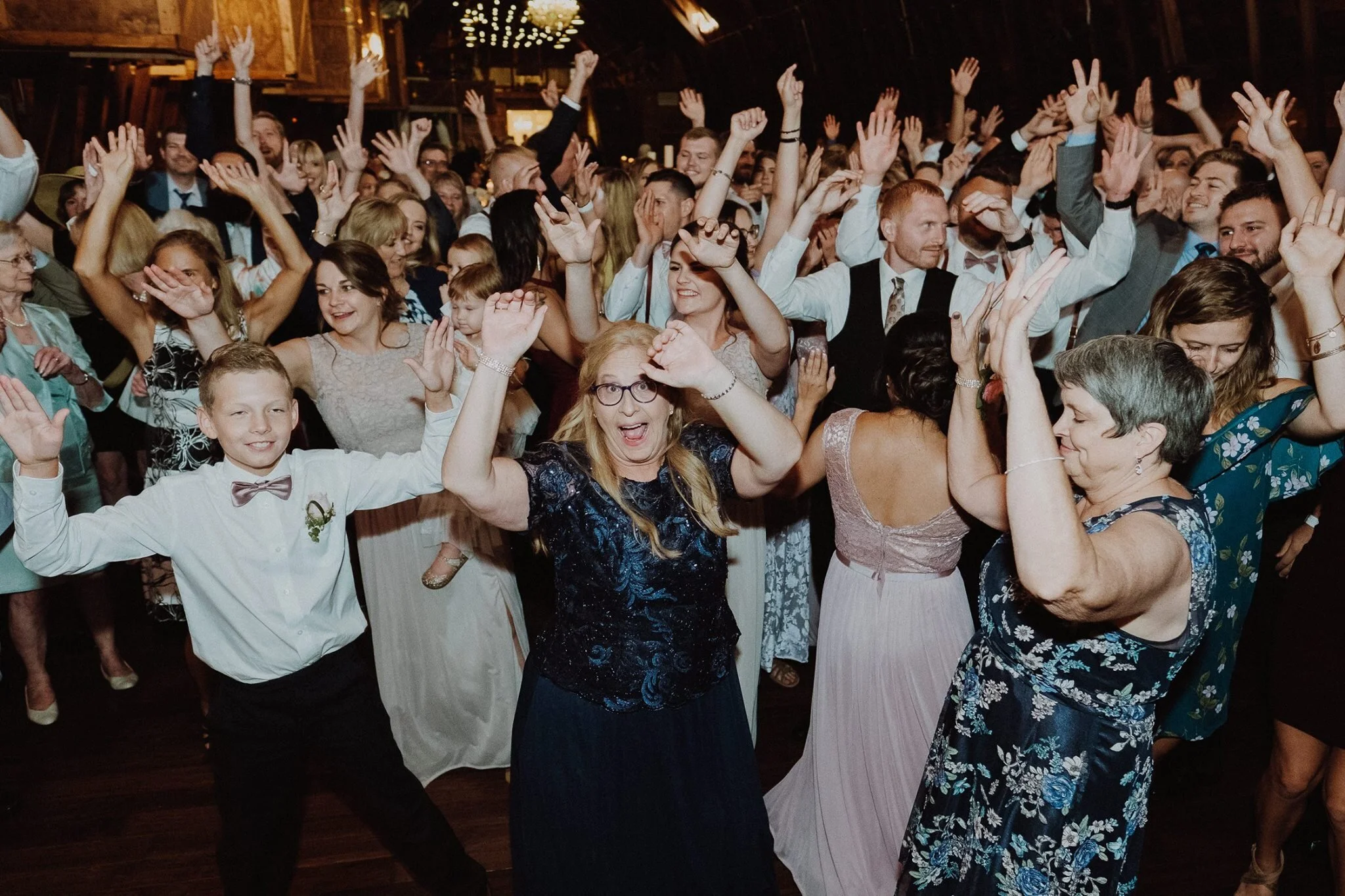
Our signature move: When you’re ready for guests to flood the dancefloor, the biggest hurdle is getting them to pay a visit. So we like to “trick” them into gathering for a group photo. We have everyone smile, then do something silly, then throw their hands in the air as the music goes up and the lights go down
For evidence, see the photo at the top of this blog post.
ACTION: Let us know you’d like to do this and we’ll coordinate with the photographer.