Turning Your Event into a Dance Party in 7 Steps
Not every wedding venue is set up for party success. From our expert-level experience, we distilled our wisdom into 7-steps you can take to maximize the fun.
Here’s an industry insider piece of knowledge:
Even most wedding planners don’t know what we’re about to share.
Here’s the secret: Long before your DJ ever drops the first song, the quality of your dance party is being determined by the venue choice and arrangement of the room.
Collectively our crew has played thousands of gigs over hundreds of venues. If you want an epic dance party at your wedding, here are the top 7 things you should consider before the day arrives …
Marry the bar and dance floor.
Space can be limited in wedding venues, so it’s common to place the bar in one room and the dance floor in the other. But that’s a mistake. People will always congregate where food and drink is. Not necessarily the dance floor. So if you put them together, you never give your guests an excuse to leave the party.
ACTION: Ask us for input on the floor plan, and always put the bar & dance floor as close together as possible.
Cozy rooms make crazy parties.
We call it room psychology. When you have 100 guests in a big room, it feels empty and (worst-case scenario) awkward. But take that same crowd and put them into a slightly-to-small room, and … BAM! Social interactions increase, the potential for dancing increases, and the overall energy goes up.
ACTION: Go for smaller venues or room arrangements that create tighter spaces.
Clap test it.
When touring wedding venues, stand in the middle of the room, clap your hands, and listen for an echo/reverberation. If you hear one, it means there’s plenty of reflective surfaces, like concrete, metal, and bare walls. Avoid if possible.
Ideally, you want a room with materials like wood, drapery, or paneling. This absorbs sound and makes a world of a difference in audio quality while reducing ear fatigue (which subconsciously gives people the urge to leave the room).
ACTION: Do the clap test, and if it echoes, either switch venues or look for ways to add sound-absorbing materials.
Adore the wood floor.
Along with helping the room sound better, wood floors are also friends to your feet. That’s because it has a slight bounce, whereas concrete wares on our feet. One thing we’ve learned from booking club events for salsa dancers: it’s wood floors or bust.
ACTION: Pick a venue with wood floors or bring in a makeshift wood dance floor.
Make the lights go low.
The whole goal is to reduce inhibition. Alcohol does that. So does darkness. When people feel less like they’re being watched, they’re given more license to be in the moment. The most important time to make that low-lighting transition is right when the dance floor opens up to the guests.
ACTION: Give ownership of this to your DJ, and they’ll discuss lighting transitions with the venue.
Gotta get up to get down.
Removing even the slightest barriers to make way for dancing makes a difference. So think about how and where people sit or stand. When you’re sitting down with your knees under a table, it takes more effort to stand up. That effort can inhibit some from making the transition to the dancefloor.
Bar stools are slightly better, cocktail tables are great, but no seating is best (if the old folks can swing it).
ACTION: If possible, don’t use dinner tables during the dance party and place cocktail tables without seating in and around the dancefloor to act as an anchor to draw people in.
Trick them onto the dancefloor.
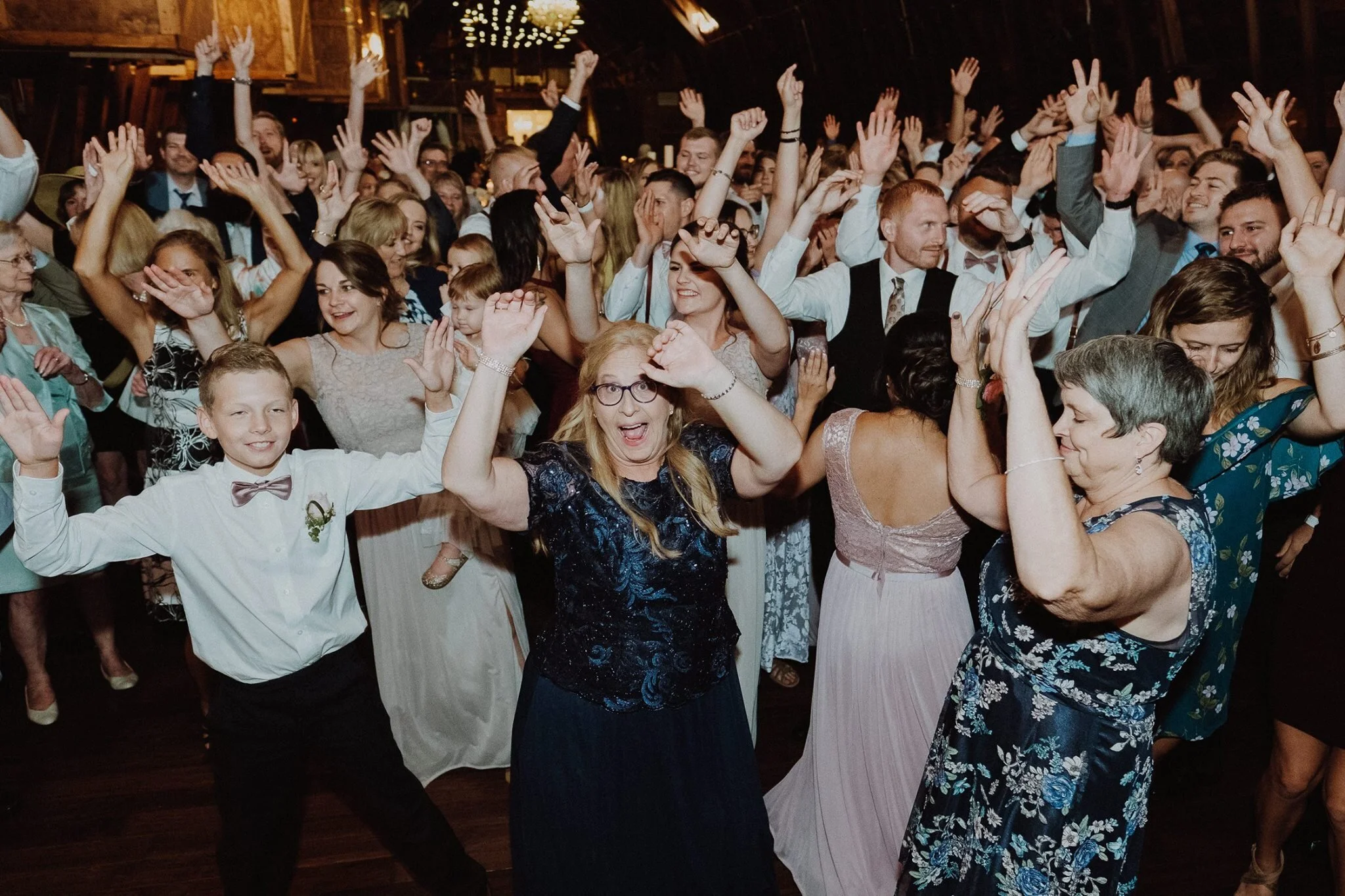
Our signature move: When you’re ready for guests to flood the dancefloor, the biggest hurdle is getting them to pay a visit. So we like to “trick” them into gathering for a group photo. We have everyone smile, then do something silly, then throw their hands in the air as the music goes up and the lights go down
For evidence, see the photo at the top of this blog post.
ACTION: Let us know you’d like to do this and we’ll coordinate with the photographer.