
Cafe Postale Weddings: Tips for Couples from a DJ | Omaha
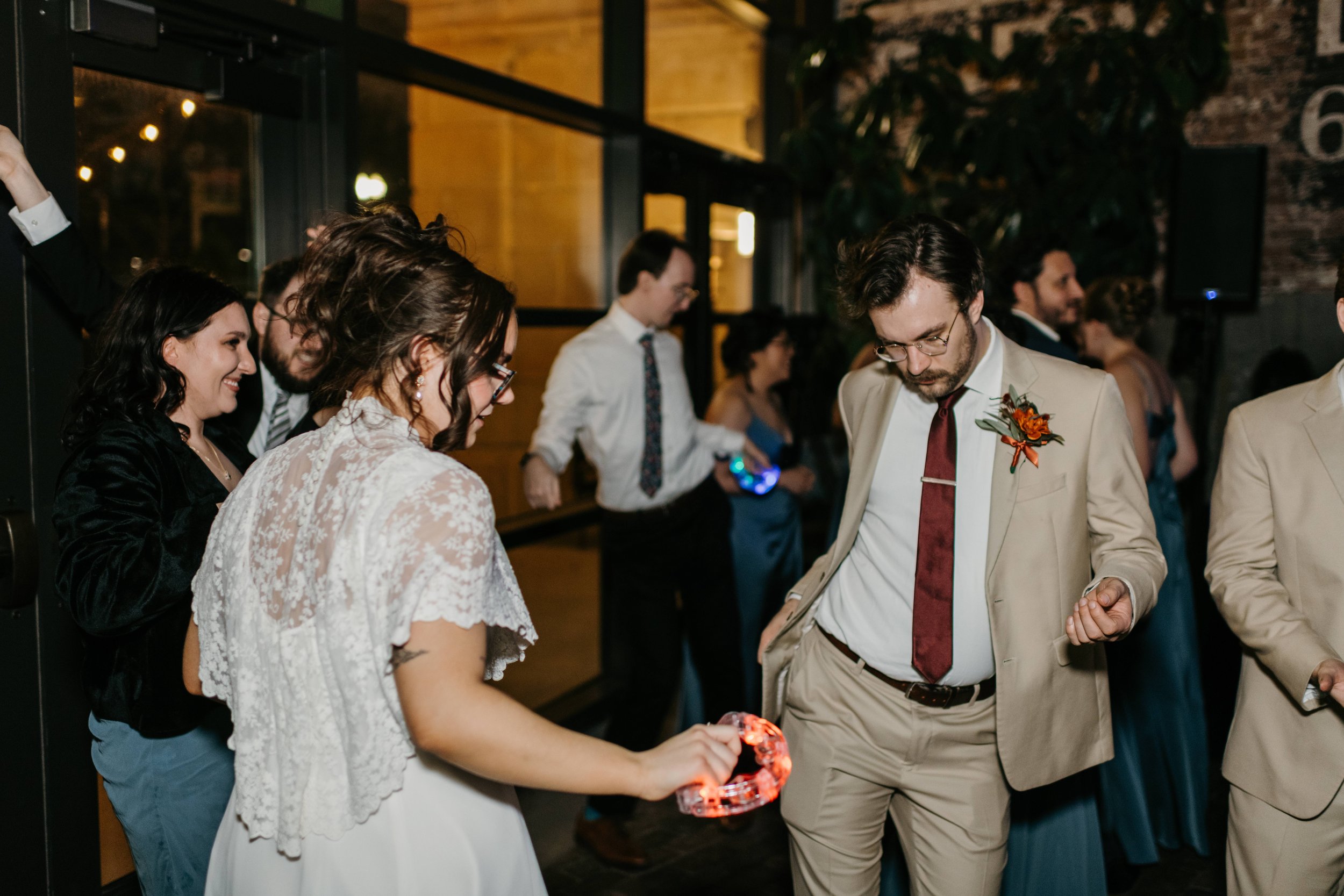
The brick you'll be dancing on used to be a street.
Café Postale sits in the Rail and Commerce Building in Little Italy, built in 1926 as the Burlington Mail Terminal. Mail trains ran into the basement, and mail trucks drove straight through the middle of the building on a brick road while inspectors watched the sorters from galleries overhead. The building was condemned before a restoration brought it back in 2017. That brick truck road is now the Northside, which is the room most couples put their reception in.
It's a good-looking room, and it's a hard one. Brick floor, brick walls, a concrete frame and tall ceilings mean sound has almost nothing to land on. The rugs and the plants are doing more work than you'd think.
Quick intro, since you're trusting us with advice: I'm Elliott Harris. I co-own Alternative Wedding DJs and run our Wisconsin office, and I've spent years programming nightclub rooms in Madison and Milwaukee. Most of what I know about dance floors I learned watching them empty.
We've played Café Postale twice. Our team ran Kaje and Madison's wedding there on September 6, 2025 alongside our partner, and Crabrangucci, who is Chalis, played Abigail and Alexander's wedding in that brick room on November 7, 2025. She still brings it up. And we have notes!
So we're gonna take that insight and deliver it to you by mail train straight into the basement, so you can skip the rookie mistakes and get the best night, with the least stress, out of your venue. Here we go.
Dancefloor strategy
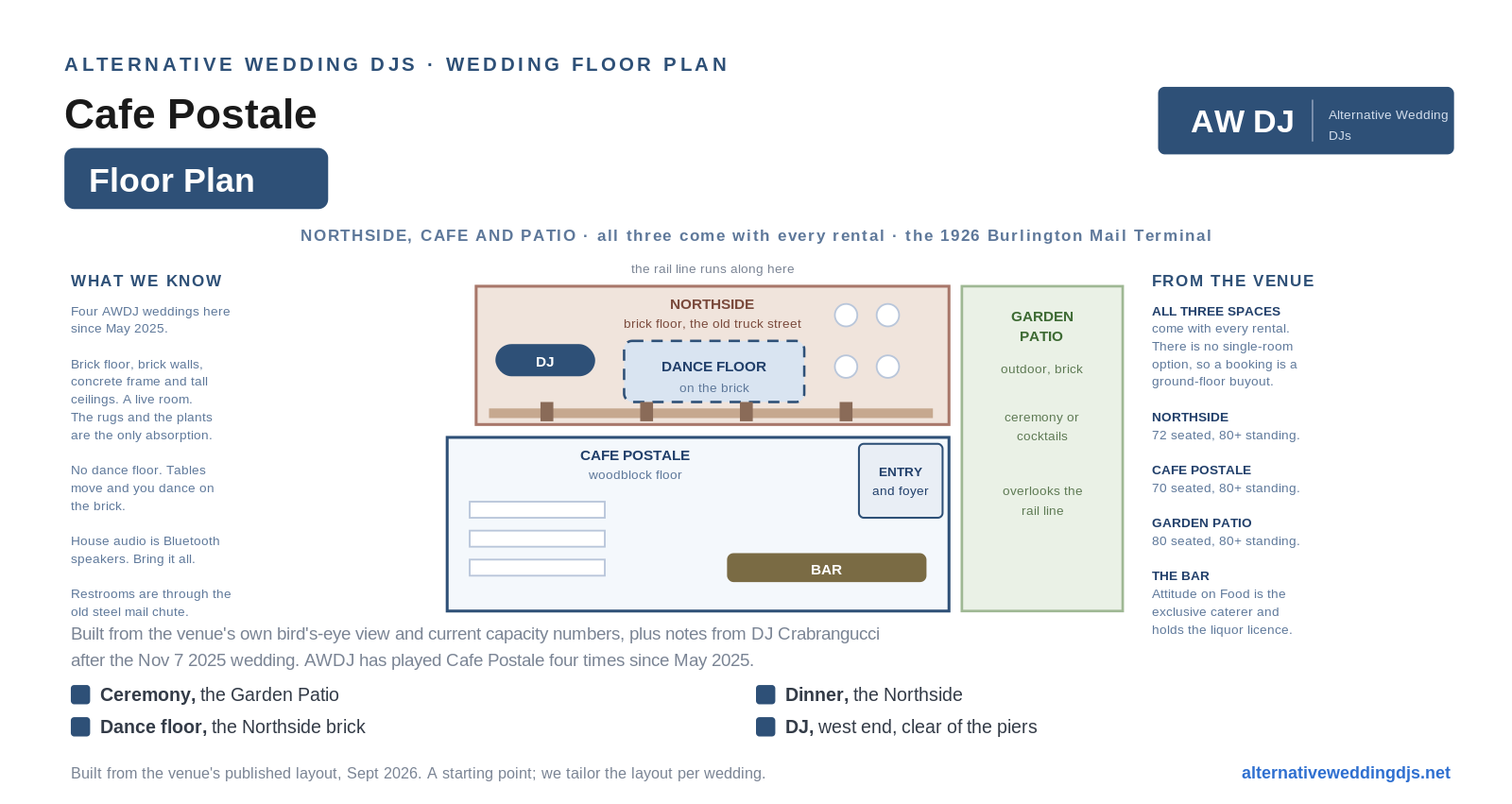
Put the party in the Northside. All three spaces come with every booking and they aren't interchangeable. The café is where the bar is fixed, so it's your bar and lounge. The patio is outdoors. The Northside is the long brick room, the one that was the truck road, and it's the only one shaped like a place people dance. Dinner and dancing go in there.
Which means you're dancing on a street. No room here has a dance floor. Tables move, rugs come up, and what's underneath is the original 1926 brick. It's a good surface and a better story, and it's worth knowing before anyone picks shoes. Ask the venue who moves what and when, because that's your changeover.
And a street has a slope in it. The truck road ran up through the building and the restoration levelled it out. Before you commit to where the dancing goes, have somebody stand in that spot and confirm the floor is flat. Nobody publishes this, and it takes thirty seconds to check on a tour.
The same construction that carried trucks is why the room is loud. Brick under you, brick walls, a concrete frame, tall ceilings. There's almost nothing for sound to land on, so it bounces and the low-mids pile up. Turning it up makes both worse. What works is tight coverage aimed down into the crowd instead of across the room, restraint on the sub, and speeches handled as their own problem. Café reviews describe the room as loud with nothing in it but conversation, which tells you what it does with a PA.
Those piers held a roof up over a road. The Northside's south wall has structural columns set between the banquette benches. They're beautiful, they're load-bearing, and they're in the way. The booth wants to be clear of them so nobody is firing into a column.
Nobody wires a mail terminal for a wedding, either. The venue's audio is Bluetooth speakers, which is right for a bridal shower and not for a reception. The full PA, every microphone, the stands and the cable all arrive with your DJ.
What to ask on your tour. Where they normally put the DJ. Where the bar sits relative to where you want the dancing. Which wall has power near it. Three answers, five minutes, and your DJ can plan the real thing instead of improvising on the day.
You can get married in there too
Having all three rooms is worth more than it sounds, because it means you probably don't need a flip at all.
The Garden Patio is the outdoor one, brick paved, looking out over the rail corridor and the downtown skyline. Planners point couples at it for ceremonies and it's the natural cocktail hour spot.
The café room works for a smaller indoor ceremony, and it's the rain plan.
So: ceremony on the patio, drinks where everyone is already standing, then dinner and dancing next door in the Northside. Nobody resets a room in the middle of your night and nobody waits around while it happens.
The patio faces the railroad the building was built to serve. Active freight line, Amtrak platform essentially next door. A train will go past at some point, and if it happens during your vows it's going to be loud. Worth deciding in advance whether you pause for it or talk over it, because whichever you pick, your officiant should know.
Insider info
Get your end time in writing. Nothing is published anywhere: no curfew, no decibel limit, no cutoff for outdoor music. What is unusual and in your favor is the neighborhood. The building is entirely commercial, there's nobody living above or beside you, the nearest housing is a couple of blocks south, and there's already a freight line making noise. That's a more forgiving spot than most of downtown Omaha. Still get the number.
The entrance is hard to find, and that matters on the day. The building fronts the 10th Street viaduct, so street level at 10th is above the café and you go down and around to get in. Guests have said so in reviews. Put clear directions in your invitations and tell your vendors, because a DJ circling a bridge with a car full of gear is time off your setup.
Outside DJs are fine. The venue recommends DJs rather than requiring them, so you can bring your own.
Valet parking is included in the rental. Worth knowing, because day-to-day parking here divides opinion in reviews. Some people find free spots adjacent to the building, others end up on the 10th Street bridge.
The café closes for private events, so you get the room to yourselves rather than sharing it with the coffee crowd.
Restrooms are through the building's original steel mail chute. It's a great detail and it's a narrow path, so it's worth knowing where it is before 200 people need it.
FAQ
Does Café Postale have a dance floor? No, and none of its three spaces do. Tables get moved and you dance on the floor that's there, which in the Northside is the original 1926 brick from when trucks drove through the building. It's a good surface and a good story. Just know it's brick when you're choosing shoes, and ask the venue who moves the tables and when.
How many guests fit at Café Postale? Every booking includes all three spaces: the Northside at 72 seated, the café at 70 seated, and the Garden Patio at 80 seated, with 80 or more standing in each. The venue's own pages also quote 100 as an overall seated maximum, so confirm your number directly rather than adding the rooms together. Older listings quoting 150 are out of date.
Does the venue provide sound, or does the DJ bring everything? Your DJ brings everything. The venue includes Bluetooth speakers, which are fine for background music but not for a reception. Plan on a full PA, microphones for the ceremony and toasts, and all the cabling coming in with your DJ.
Where should the DJ and the dance floor go at Café Postale? Put the party in the Northside room. It's the one with the space and the right shape for a floor, and it keeps the music off the rooms you want people talking in. Check the floor level on site, because the Northside floor reads as a slight ramp, and a laid dance floor on a slope is a conversation you want to have before the day rather than during setup.
Getting married at Café Postale?
We have a team of Omaha and Lincoln DJs ready to go, and we've played that brick room four times.
