
The Paxton Ballroom Weddings: Tips for Couples from a DJ | Omaha
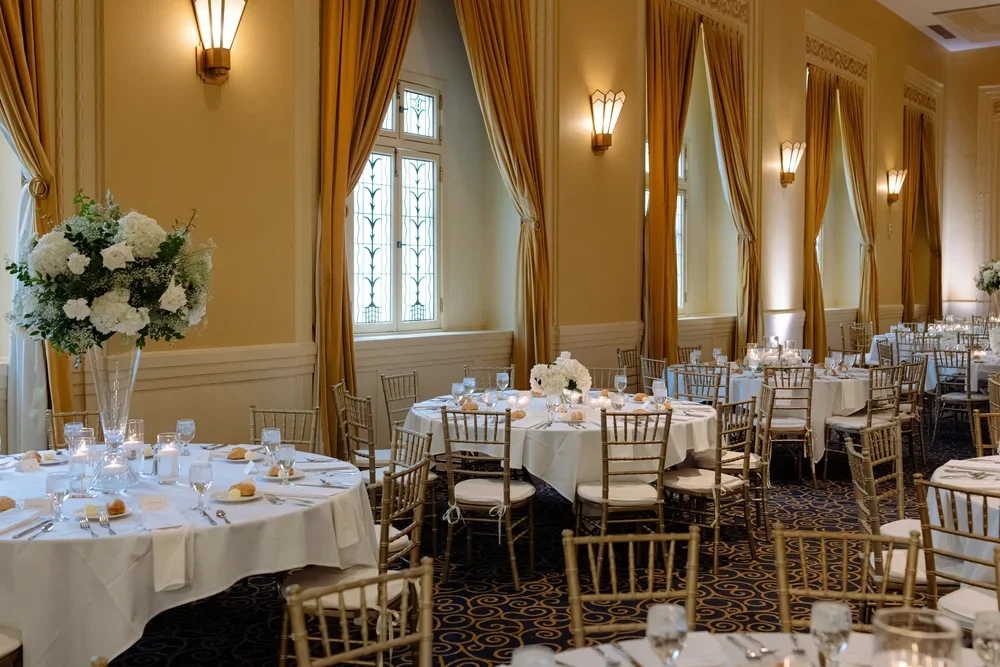
Your guests are going to walk in under an illuminated marquee on 14th Street, take an elevator up one floor, and step into a 1929 ballroom with molded plaster ceilings, chandeliers, wall sconces, and a run of tall windows behind floor-length gold drapes. It's a beautiful room, and there's a real stage at one end of it, which almost no Omaha venue has.
Here's the number that matters more than any of that: your end time, and it might not be the one on the website. The Paxton's published rule is that events end by midnight with a six-hour cap. The reception we DJ'd there had a hard stop at 11. There are condos on ten floors directly above the ballroom, so whichever number is in your contract is the number, and couples routinely find out after they've signed.
Quick intro, since you're trusting us with advice: I'm Elliott Harris, co-owner of Alternative Wedding DJs and the person who runs our Wisconsin office. I started on radio straight out of high school, got my degree at the Conservatory of Recording Arts and Sciences in Arizona, and spent time at Can Am Studios in LA before family brought me back to the Midwest. Since then I've spent years booking and programming rooms for hospitality groups in Madison and Milwaukee, on top of the weddings. Between the club nights and the dance floors, I've learned why a room fills or empties, and how a space's size and layout shape the whole night.
Our team has played The Paxton Ballroom, most recently a reception run by Yascoe in August 2026. Which also settles something: you can hire an outside DJ here. Older listings around the internet still say the venue has an exclusive DJ contract. The current official pages don't say it, Abraham Catering's own FAQ talks about coordinating with outside DJs, and we've played the room. If you found the old information and assumed your hands were tied, they aren't. And we have notes!
So we're gonna take that insight and deliver it to you in the original 1929 elevator, operator and all, so you can skip the rookie mistakes and get the best night, with the least stress, out of your venue.
Here we go…
Dancefloor strategy
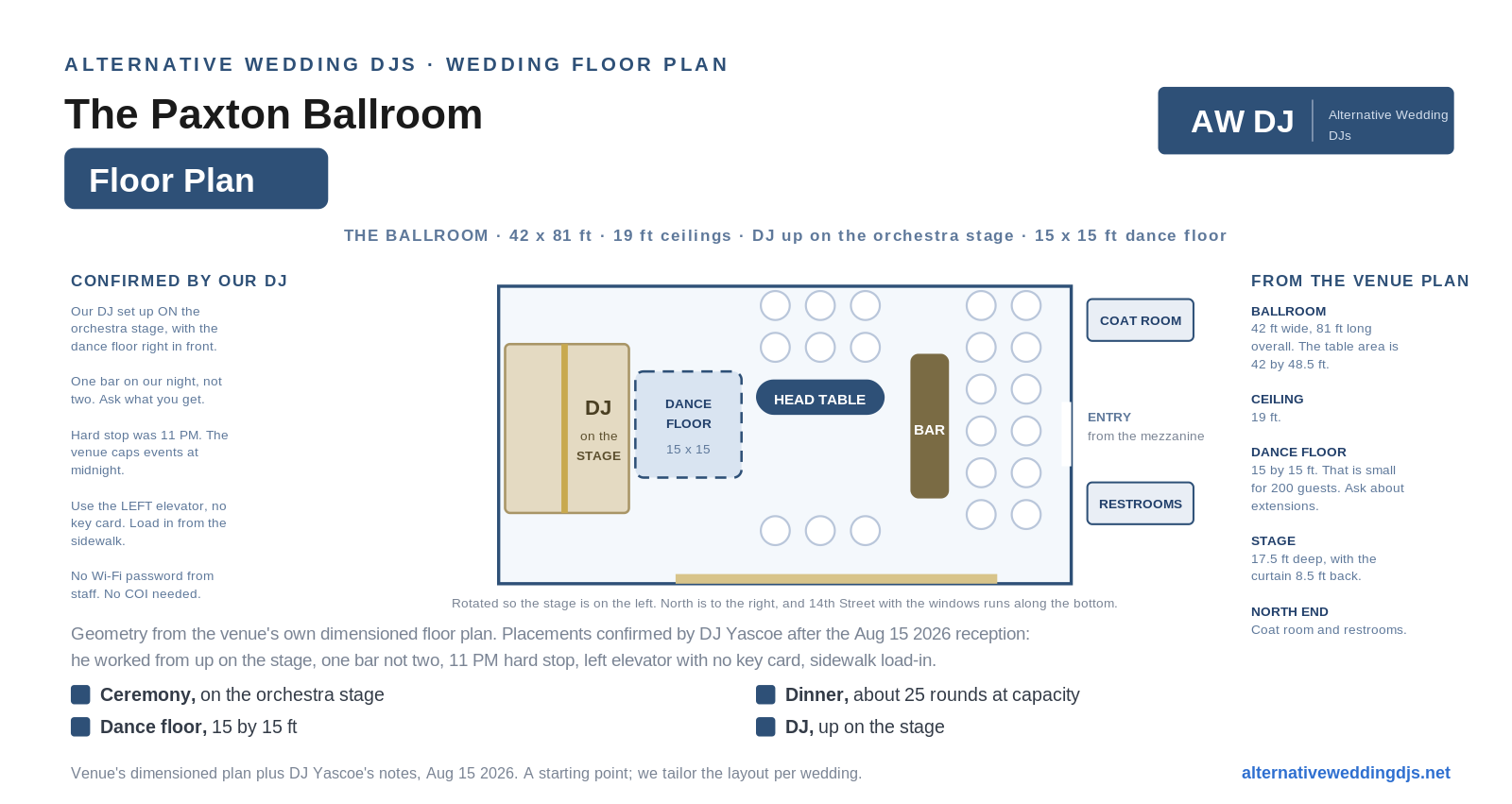
The dance floor is 15 by 15 feet, and that's the number to budget around. It's on the venue's own dimensioned plan. 225 square feet holds roughly 45 to 50 people dancing at once, in a room that seats 200. It's a laid floor rather than a permanent inlay, so it extends, and a couple on The Knot has said outright that they rented extensions. Price that in on day one rather than finding out two weeks before the wedding.
The booth goes up on the stage, and we know because that's where ours was. The room has a built-in Orchestra Stage at the south end, 17.5 feet deep with a gold curtain 8.5 feet back, and it's a real stage. Couples have fit an eight-piece band on it, or a wedding party of eleven plus an officiant and a chuppah. Our DJ worked from up on it with the dance floor straight in front, which is the right answer: elevated, backed by the curtain, and every cable run stays off the paths your guests walk.
One long room, so watch where you seat people. The ballroom is 42 feet wide and 81 feet long, with 48.5 feet of that being the table area north of the dance floor. Your guests come in at the north end and the stage is at the far south end. That's a long walk, and the tables at the north end are a different wedding from the tables near the floor. Put the people you're counting on to dance closest to it.
This room is bright on top and soft in the middle, which is an unusual combination. The ballroom is carpeted, there are heavy drapes down the window wall on the 14th Street side, and 200 people at linen-covered rounds absorb a lot. But the ceiling is 19 feet of molded plaster, with plaster walls above the drape line, and all of that reflects hard. The practical result is slap coming off the ceiling and low-mid energy piling up at the stage end. The fix is coverage aimed down into the crowd rather than thrown across the room, and a bit of care with the low-mid on the EQ. Any DJ who's worked a historic ballroom will know to check this during setup. Ask yours whether they will.
Ask how many bars you're getting, then ask where they go. The inclusions list says two portable bars. Our night had one. Portable means placement is a conversation rather than a fixed feature, and that's the advantage worth using. Bar crowd and dance crowd in one zone makes a party feel busy; a bar at the far end from the floor splits an 81-foot room into a dance half and a standing-around half. In a room this long that lever matters more than usual, so pull it: get the bar down toward the dance floor end.
Dancers close, talkers back. Seat the people who'll dance at the tables nearest the floor and the catch-up relatives farther out. It matters in every room and it matters more in a long one.
And plan the last hour like it's the last hour. With a hard midnight end and a six-hour event, there's no "we'll just go a bit longer." Your DJ should be building toward a real peak and a real close on a known clock, not hoping for overtime that isn't available.
You can get married in there too
Indoor only, and the flip is the standard pattern here. There's no outdoor ceremony space at The Paxton. What couples do, and reviews describe it consistently, is get married in the ballroom itself, often up on the stage, then send guests out to the Second Floor Mezzanine or down to the two-story lobby for cocktail hour while staff reset the room to rounds. It's been done for a 240-guest wedding, and the typical window is about an hour.
Three things to know about that.
A flip means a second sound zone. While your guests are on the mezzanine or in the lobby, they need music out there, and those are the hardest surfaces in the building. The lobby is terrazzo tile, marble and granite in a two-story volume, so anything you put in it will ring. That's a small speaker placed thoughtfully and run at conversation level, not a second full rig, and your DJ should be planning for it rather than discovering it.
Confirm the mezzanine is still yours. The old rental explicitly included the ballroom plus the Second Floor Mezzanine. The current inclusions list doesn't mention it, and Eventective still shows the mezzanine as its own event space. Since the mezzanine is where your cocktail hour goes during the flip, this is not a detail to leave loose.
Ceremony audio is on your DJ. More on that below, but if you're getting married in the room, the microphone your officiant and your vows go through is equipment somebody has to bring.
Insider info
Your end time is the whole conversation, and it may not be midnight. The venue's published rule is that events end by 12:00 AM with a six-hour cap. The reception we played had a hard stop at 11 PM. So don't assume you have until midnight because a website says so. Get your number out of your contract, in writing, before you build a timeline. Omaha's quiet hours start at 10pm and there are residential condos on the ten floors above the ballroom, so nobody is bending it on the night. If you want a real dance window, watch how much of your hours go to a ceremony and a long dinner service.
Bring a hotspot, and tell your DJ to. At our wedding there, venue staff couldn't produce a Wi-Fi password and our DJ ended up pulling internet off a nearby restaurant. If your DJ streams any part of their library, that's a night-ruining problem with a pocket-sized fix. Ask them what happens if the venue Wi-Fi doesn't exist.
Assume the venue provides no audio. No PA, no microphones, no projector on the current inclusions list. House AV was on an older version and Visit Omaha still mentions it, so it looks like it's been dropped. Get it in writing either way, and plan on your DJ bringing the PA, the ceremony mic, the toast mics, and any uplighting.
The ballroom is on the second floor, and here's the route. Everything comes off a busy downtown street and goes up. Our DJ loaded in off the sidewalk on 14th Street and took the left elevator, which doesn't need a key card. Downtown parking is tight enough that parking on the sidewalk to unload is the practical move. There's no loading dock and no service elevator that anyone publishes, so if you're hiring a vendor with heavy gear, tell them the route: sidewalk, main entrance, left elevator, one floor up. 14th Street also has streetcar construction along it, so don't count on a long stay at the curb.
Parking comes with a code, and get the code yourself. Your rental includes parking in the Omaha Park 2 garage at 14th and Harney, about half a block away, and it needs an access code. There's a review describing guests stuck in the garage until on-call staff sorted it out. So: get the code in writing, put it in your guest communication, and give it to your vendors too. There's limited on-site parking and plenty of other paid garages and lots downtown as backup.
Cold sparks and fog: get it in writing. There's no published policy, but the venue's own gallery includes a photo of a couple on the stage with sparklers going on either side, and another showing sparkling light effects on the ceiling. So it's been done in that room. Given the plaster ceiling, the drapery, the carpet and the condos overhead, I would not treat gallery photos as permission. Ask, and ask whether the fire marshal needs to sign off.
One event per day, but same-night teardown. Because they only run one event, early access for setup and decor is flexible and coordinated with your venue manager. The catch on the other end: decor has to come out immediately after the event. No collecting things in the morning. Assign that job to somebody who isn't going to the after-party.
You get a dedicated venue manager, and reviews are consistent that this person runs the flip and helps line up the grand entrance. That's a real asset, and it means your DJ has somebody to coordinate with. Historically that's been Chad (at the time of writing this).
No insurance certificate needed. The Paxton didn't ask our DJ for one.
The staff are good. Every review says it and our DJ said it too: helpful on the night, and they sent him off with a to-go box of food. After a section full of warnings, that's worth saying plainly.
If your count is bigger
Here's a discrepancy you need to resolve in your contract, not from a blog. The current official page, the FAQ, Zola and The Knot all say 200 seated, 300 standing. The legacy Paxton material and the Visit Omaha listing say 370 for table seating and 414 theater-style, and Eventective still shows 370.
That's a big gap, and there's a clue in the inclusions: chairs are capped at 200 gold Chiavari chairs. Over 200 and you're renting chairs, which suggests 200 is the number they're set up to serve. Table inventory runs to roughly 25 large rounds plus 9 smaller ones, six and eight-foot banquet tables for the head table, gifts and cake, and a handful of tall cocktail tables.
Treat 200 as the working number and confirm anything above it explicitly. The other spaces in play are the Second Floor Mezzanine and the ground-floor two-story lobby, which several couples have rented for cocktail hour. There's also a rooftop deck at the top of the building, reached by elevator, but it's a condo amenity used for skyline photos and it isn't an event space.
FAQ
What time does a wedding at The Paxton Ballroom have to end? The venue's published rule is midnight, with a six-hour cap, but your contract may be earlier. The reception we DJ'd there had a hard 11 PM stop. Get your actual end time in writing rather than assuming you have until midnight, and remember there are ten floors of residential condos above the ballroom, so nobody is bending it on the night.
Can you bring your own DJ to The Paxton Ballroom, and does the venue provide sound? You can bring your own DJ, and no, there's no sound included. Some older listings still say the venue has an exclusive DJ contract, but the current official pages don't, Abraham Catering's own FAQ describes coordinating with outside DJs, and we've DJ'd a reception there. What the rental doesn't cover is audio of any kind: no PA, no microphones, no projector. Plan on your DJ bringing all of it, mics for the toasts included. Food and alcohol are a different story, both are exclusive to Abraham Catering, though outside desserts are allowed.
How big is the dance floor at The Paxton Ballroom? 15 by 15 feet, per the venue's own dimensioned floor plan. That's 225 square feet, which holds roughly 45 to 50 people dancing at once in a room that seats 200. It's a laid floor rather than a permanent inlay, so it can be extended, and couples do rent extensions. Ask what the extensions cost before you sign, because it's the difference between a full floor and a crowded one.
Can you have your ceremony and reception in the same room at The Paxton? Yes, and it's the standard pattern. Couples get married in the ballroom, often on the orchestra stage, then guests move to the second-floor mezzanine or the two-story lobby for cocktail hour while staff flip the room to dinner rounds. Ask whether a ceremony fee applies and whether mezzanine access is included, because both appeared on older rate sheets and are absent from the current one.
Getting married at The Paxton Ballroom?
We have a team of Omaha DJs ready to go, and we've played the room.
Worth a read before you lock your timeline, given the midnight cutoff: the case for a 5-hour reception. And if you want to think about how the room gets set up, 7 Steps to Make a Danceparty.
