
Zenia Omaha Weddings: Tips for Couples from a DJ | Omaha
Your guests walk in under a gold dome. Zenia is a 2024 build on Omaha's western edge in Elkhorn, and the ballroom runs 84 by 72 feet with 22-foot coffered ceilings, a warm plank floor, tall windows, and an amber panel set into the middle of the ceiling that filters daylight down into the room. The name comes from the Greek word for hospitality, which tells you something about how the place is run.
Most venues hand you two or three set layouts and you pick one. Zenia doesn't work that way. They build your floor plan with you, around your guest count and what you want the night to feel like. That's better for you, and it puts a question in your hands that the venue would otherwise answer for you: where does the DJ stand?
Quick intro, since you're trusting us with advice: I'm Elliott Harris, co-owner of Alternative Wedding DJs and the person who runs our Wisconsin office. I started on radio straight out of high school, got my degree at the Conservatory of Recording Arts and Sciences in Arizona, and spent time at Can Am Studios in LA before family brought me back to the Midwest. Since then I've spent years booking and programming rooms for hospitality groups in Madison and Milwaukee, on top of the weddings. Between the club nights and the dance floors, I've learned why a room fills or empties, and how a space's size and layout shape the whole night.
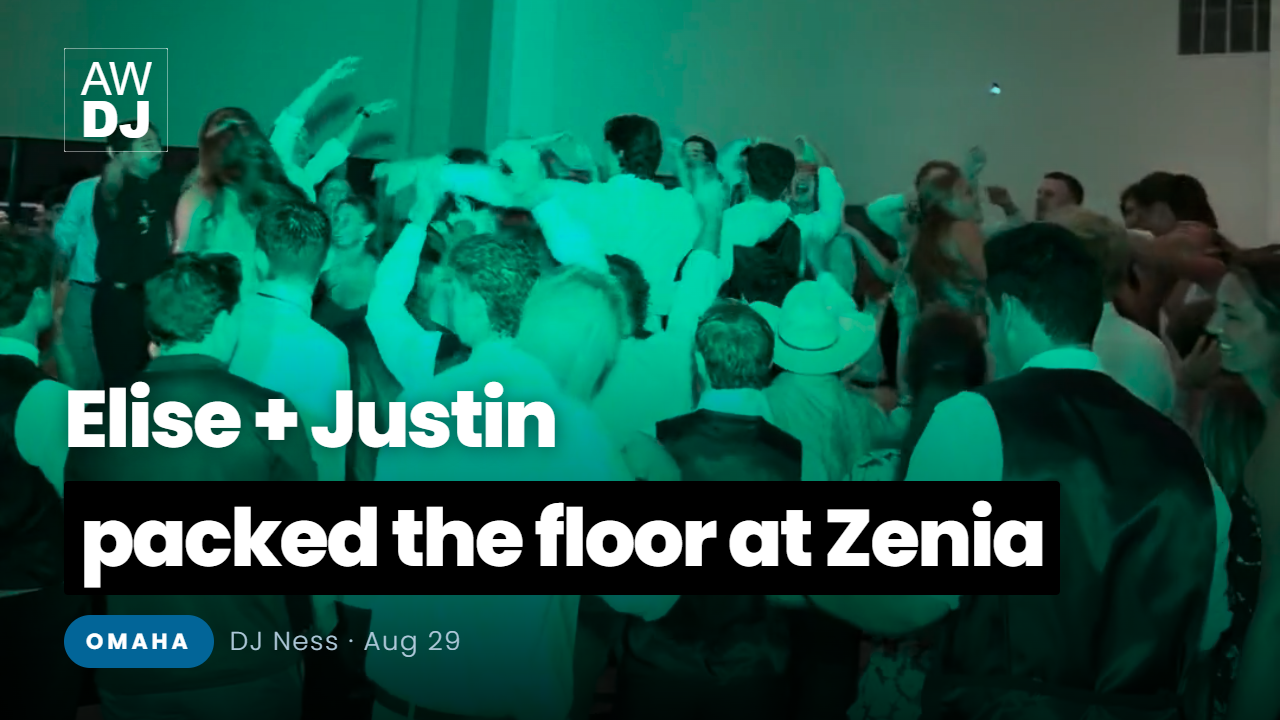
I DJ'd Elise and Justin's reception at Zenia on August 29, 2026, a bridal party of thirty and around 300 guests in the room. That's one night in that building for us so far, and it's mine. And we have notes!
So we're gonna take that insight and deliver it to you in a hot-air balloon tethered to that gold dome, so you can skip the rookie mistakes and get the best night, with the least stress, out of your venue.
Here we go.
Dancefloor strategy
Ask for the booth right up against the floor.
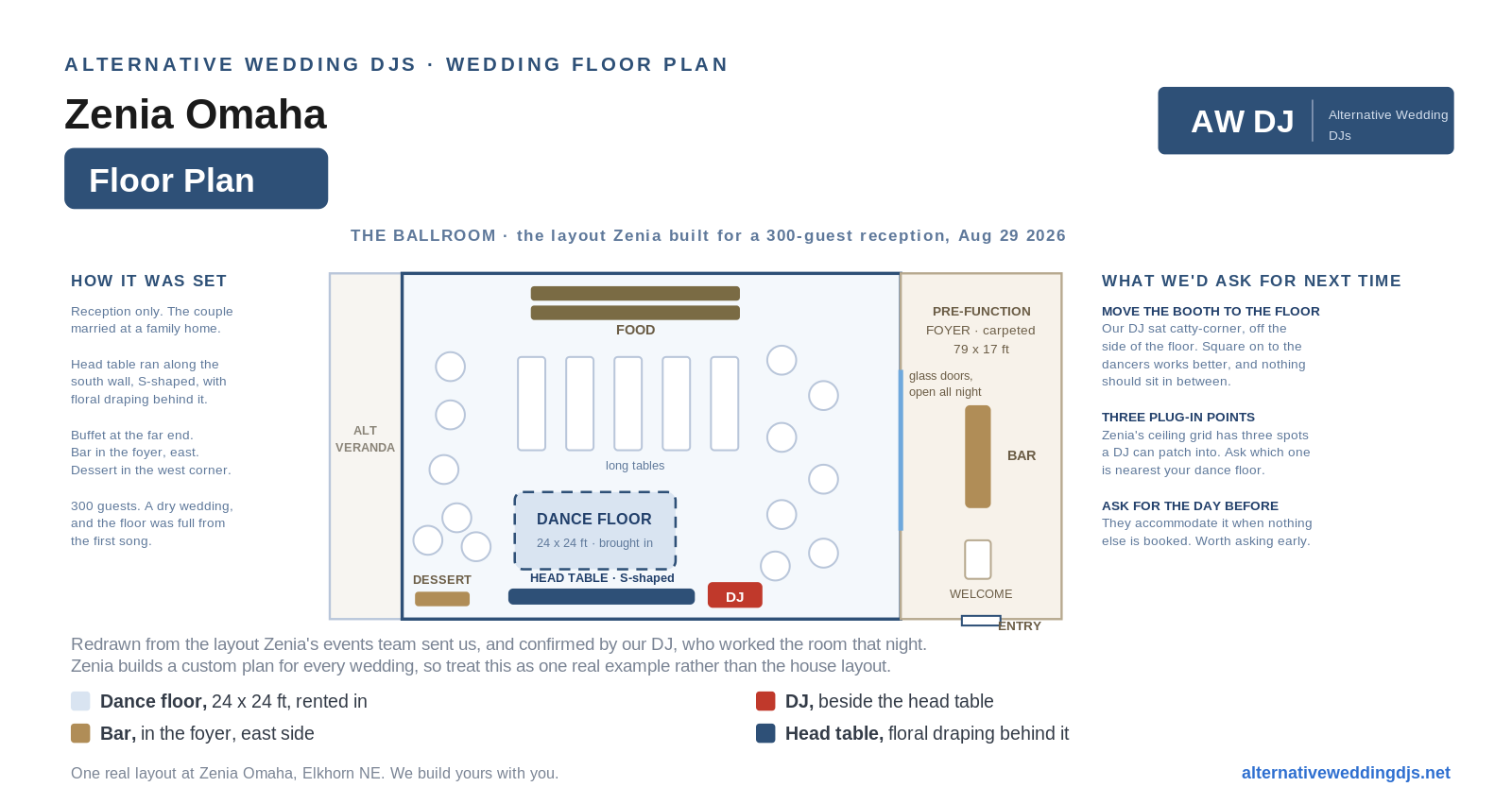
At the wedding I played, the head table was a big S-shaped run along one wall with room for a bridal party of a dozen or more on each side, and the couple put me right beside it. That's a good spot for being part of the head table's world. It put me at an angle to the dance floor rather than square on to it.
The night worked. People danced from the first song to the last, and I'd take that layout again happily. But since you're the one who gets to choose, here's what I'd choose: the booth square on to the floor, as close as the plan allows, and nothing sitting between the two.
That last part matters more than it sounds. Empty tables parked between the booth and the dance floor put distance in the way, and distance is the thing that breaks the read. I can still hear the room from twenty feet back. What I lose is the faces, and the faces are how I know whether the floor is about to turn. When I can see you, I can catch it. When I'm across a row of vacant chairs, I'm guessing. Ask your coordinator to keep that lane clear.
There are three places a DJ can plug into the house system. Zenia's ballroom has a built-in system with three primary patch points, so if your DJ wants to run through the ceiling grid, there's a spot for it. Ask which of the three sits closest to your dance floor, because that answer shapes your whole layout.
The ceiling is doing more work than you'd think. This surprised me and it's the most useful thing Zenia's team told us. The ceiling grid speakers are deliberately not aimed straight down. They're angled to spread sound across the room and keep dead spots, reverb and echo from building up, and the ceiling panels themselves are built to absorb. Zenia did that on purpose so the room could stay clean and elegant without hanging drape everywhere or putting carpet down. For a 22-foot ceiling over a hard plank floor, it's a smart build.
What that means for you: this room behaves better than its materials suggest, and you don't need to solve it with fabric. Your DJ still has to aim coverage down into the crowd rather than throwing it across the room, still has to keep the low end tight, and still has to ride mic levels carefully during toasts. That's true in any big room. You just aren't fighting the building here.
Size the sound to your headcount. We had around 300 guests and the couple wanted it loud, so I brought more than the room would suggest and ran it harder than I usually do. Tell your DJ your real number early. It's what decides how much gear shows up.
No columns. The ballroom is clear span. Sightlines are clean and speaker placement isn't working around structure.
The dance floor comes from outside. Zenia doesn't own one. It's brought in by one of their partners for events that need it, which is why the size is a conversation rather than a fixed thing. Ours was 24 by 24 feet for 300 guests, and it was right. Ask what size you're getting, because in a room this big the difference between a 20-foot floor and a 28-foot one is the difference between crowded and comfortable.
Dancers close, talkers back. Put the people you're counting on to start the dancing at the tables nearest the floor. A floor that opens with eight people who want to be there fills. One that opens empty stays empty another forty minutes.
The foyer is the relief valve. It runs the full length of the ballroom's east side, it's carpeted with a dropped acoustic ceiling and lounge seating, and it's the one quiet surface in the building. Guests who came to talk will find it. That's a feature, not a leak, and it's where cocktail hour wants to be.
You can get married in there too
Straight with you: I haven't run a ceremony at Zenia. The wedding I played was a reception only, and the couple married at a family home fifteen minutes away. So this is what Zenia offers rather than what I've done, and I'd rather say that than pretend.
Three options, two of them outdoors. The Courtyard is open-air with the ballroom's floor-to-ceiling windows looking onto it. The Green at Zenia is the other outdoor spot. Or you marry indoors in the Ballroom. Zenia's team works through it with each couple rather than pushing one answer, which is the right way round.
Chairs are covered, indoors and out. Zenia provides them for both. You aren't renting ceremony chairs separately, which is a line off the budget most couples assume they'll be paying.
On the reset between ceremony and reception, there's no published number and that's deliberate. Their events team doesn't want to promise a turnaround time that won't fit your particular timeline. So it's a conversation with them when you build your day, not a figure you look up. If you're marrying in the ballroom, have that conversation early, because the answer decides your cocktail hour.
One thing only this venue raises. Zenia sits on the campus of a Greek Orthodox church, and they've hosted Greek Orthodox weddings in the ballroom. Alcohol isn't an issue. Allison's note is that fasting days are the part worth asking about, so if your date lands near one, raise it.
Insider info
Midnight is the end, and it's not about the neighbors. The room is yours from 10am to midnight and you structure those hours however you want. The one firm rule is that the party ends at midnight. Ending earlier is your call. The wedding I played wrapped at 10pm because that's what the couple wanted. And the cutoff is an insurance and liability rule, not a noise complaint. There's a senior living community nearby and Allison's read is that most of them enjoy the wedding traffic more than they mind it.
No indoor decibel limit. You can have a loud wedding here. Outdoor events fall under the city's 11pm noise ordinance, so if you're doing anything amplified on The Green or in the Courtyard, that's the number that matters.
Ask about setting up the day before. I set the room up on the Friday for a Saturday wedding, and for a room this size that's a real advantage. Zenia tries to accommodate it and can't promise it, since it depends on whether something else is booked. Worth asking early rather than assuming either way.
Load-in is as easy as it gets. Ask where your vendors park. Zenia's own materials call it a zero-entry loading area: flat, grade-level, no dock, no stairs, nothing to lift, and the whole building is single storey. Bring a cart and you're done. The lot holds about 300 cars, and Zenia tells clients where vendors should park, so get that instruction and pass it to yours. If your guest list is big, ask about the overflow arrangements they have with nearby businesses.
There's house AV, and it's good at what it's for. Dual screens and projectors, microphones, drop-down screens, internet and a DJ table, wired in and up to current spec, plus the ceiling grid I mentioned. I ran my own rig for the reception because that's how I work, but a DJ who wants to patch in can. Talk to your DJ about which way they'd rather do it, and ask Zenia's team about the three plug-in points.
Outside DJs are welcome. Zenia keeps a preferred vendor list and says so openly, and there's no exclusivity attached to it.
You get the building. Zenia doesn't book other events on a wedding day, and the church coordinates around bookings in both directions. So you aren't sharing a wall with somebody else's party, which is not something every venue in this metro can say.
Your contact is Allison, Director of Events and Sales (at the time of writing this).
If your count is bigger
Zenia can hold a lot of people, and for weddings they deliberately don't. Galas run up to around 500. For weddings the cap is 400, and their events team aims to keep it at 350 or under. 300 to 350 is the sweet spot.
That's a venue turning business away to protect the experience, and as the DJ in the room I'll back the call. We had around 300 and it felt full and comfortable. Another hundred bodies and the floor starts competing with the walkways.
The room worth knowing about is the Foyer, also called Pre-Function. It runs 79 by 17 feet down the ballroom's east side with its own bar, carpet underfoot, lounge seating and a dropped acoustic ceiling. It's the quiet room, and every wedding needs one.
Other spaces on the campus: the Courtyard, The Green at Zenia for tenting, a Breakout Room and a Board Room.
FAQ
What time do weddings at Zenia Omaha have to end? Midnight. You rent the room from 10am to midnight and you build your timeline however you like inside that window, but the party ends at midnight and that's firm. It's an insurance and liability requirement rather than a noise rule. Ending earlier is entirely your call, and plenty of couples do.
Does Zenia have a dance floor, and how big is it? Zenia doesn't own a dance floor. One gets brought in by a partner vendor for events that need it, so the size is something you decide rather than inherit. Ours was 24 by 24 feet for about 300 guests and that was the right call. Ask what size you're getting, because in a room this big the difference between 20 feet and 28 is the difference between crowded and comfortable.
Can you bring your own DJ to Zenia Omaha? Yes. Zenia keeps a preferred vendor list and recommends from it, but there's no exclusivity, so you can bring the DJ you want. The ballroom also has a built-in system with three places a DJ can plug in and run sound through the ceiling grid, if that's how your DJ prefers to work.
How many guests fit at Zenia Omaha? For a wedding, 400 is the ceiling and 300 to 350 is where the room is at its best. Zenia's events team caps weddings deliberately, even though the ballroom can take up to about 500 for a gala-style event. Confirm your number when you sign.
Worth reading before you lock the timeline, given the midnight cutoff: the case for a 5-hour reception. And for how the room gets set up, 7 Steps to Make a Danceparty.
