
The Waterfront Hotel Weddings: Tips for Couples from a DJ
Picture your reception 25 feet above the Mississippi, on a rooftop terrace with the river running past and the downtown lights coming up behind you. That's the whole draw of The Waterfront Hotel in Prairie du Chien, and it's a real one. A brand-new riverside venue: a covered rooftop terrace with a peaked, draped ceiling and string lights, and a full wall of glass doors that open to the river. Your guests are going to remember walking up there.
There's a tradeoff worth knowing about. The terrace has a roof and drapery overhead, so it holds sound better than a truly open-air deck, but that whole river wall is glass doors that open to the outside. A sealed ballroom bounces energy back into the room and does some of the work for you. Here, whenever those doors are open, a good share of the sound drifts out toward the water. So the feel of the party rides on how the DJ sets up and reads the floor, more than in an enclosed room.
Quick intro, since you're trusting us with advice: I'm Elliott Harris, co-owner of Alternative Wedding DJs. Off the wedding calendar I'm a Director of Entertainment for a hospitality group, programming nightclub rooms most weekends, and I came up through radio and the Conservatory of Recording Arts and Sciences. Between the club nights and the weddings, I've spent years learning why a room fills or empties, and how a space's size and layout shape the whole night.
So we're gonna take our insight and deliver it to you on a pontoon boat drifting down the Mississippi, so you can skip the rookie mistakes and get the best night, with the least stress, out of your venue. Here we go…
Where the DJ booth goes
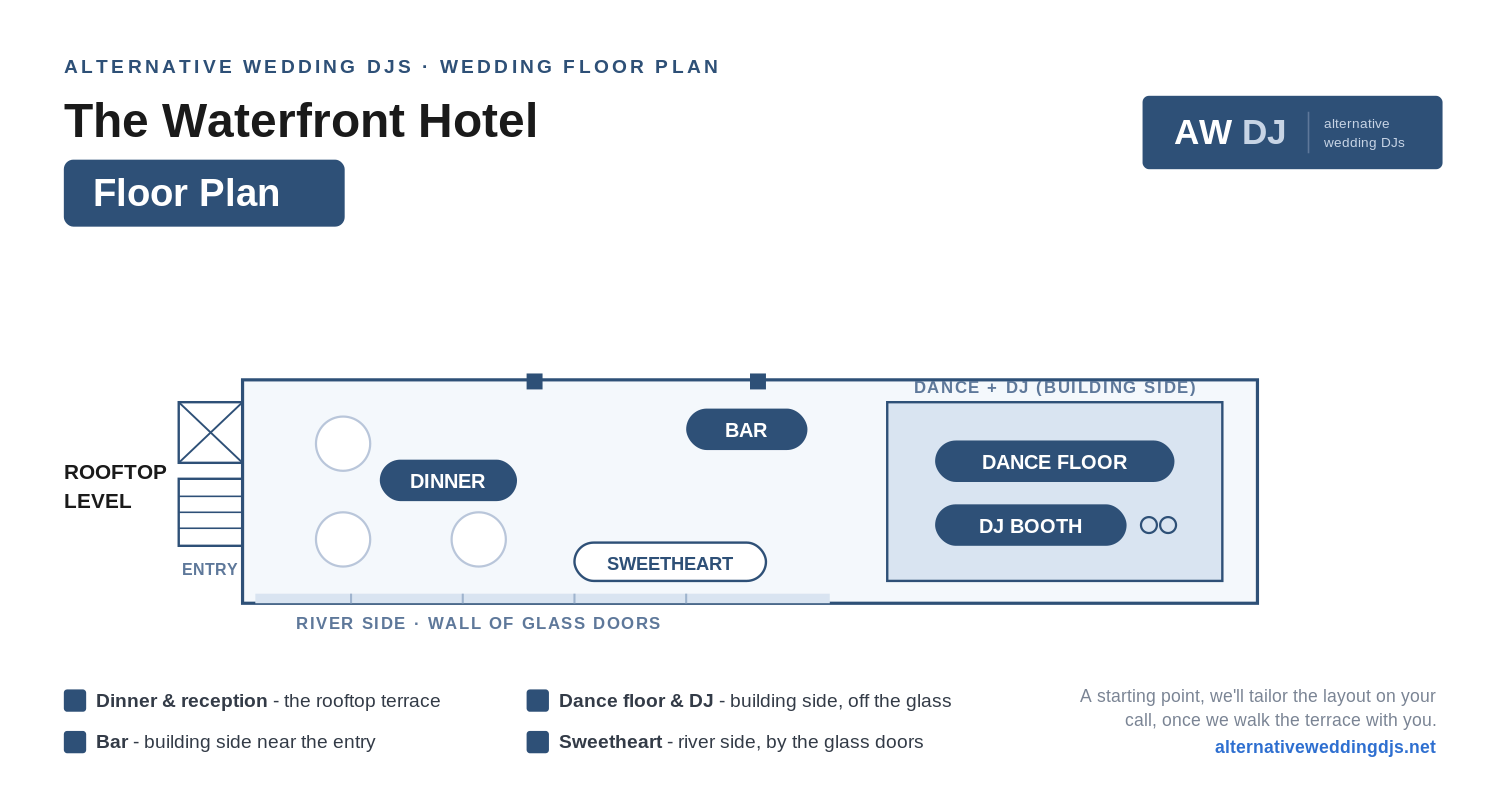
We've sketched a starting layout from the venue's rooftop video and photos, and we'll lock the exact spot when we walk the terrace with you. The principle holds either way.
With a whole side open to the river through glass doors, the worst place for the booth is anywhere the speakers fire out toward that open glass wall. Sound that leaves toward the water is sound your guests never hear, and you end up chasing volume to make up for it. So the move is to set the booth with its back toward a solid surface, the building wall, and aim the system back across the deck at the crowd. That keeps the energy on the dance floor instead of sending it out over the Mississippi.
We also want the booth close to the dance floor and the bar, not tucked in a far corner. The tighter that zone is, the more the party feels like one thing instead of three separate ones.
Dance floor strategy
The venue provides a dance floor, which is great, because a defined floor tells guests where the party is. A couple of things we'd plan around here.
Put the dance floor between the booth and the seated tables, not out toward the open rail. You want dancers pulled into the center of the deck where the sound is strongest, not drifting to the edge. Seat your dancers, the friends who are going to be up all night, at the tables closest to the floor. Put the folks who came to talk farther back. That's not rude, it's how you get a floor that fills early and stays full.
If the bar sits near the dance floor on the terrace, that's a gift. Condensing the bar line and the dance crowd into one zone dials the whole party up, because nobody has to leave the energy to get a drink.
How the room sounds
The terrace sits between two worlds acoustically, and a good DJ plans for both.
The roof and the draped ceiling overhead give you some containment, so it's not the dead, no-reverb situation of a fully open deck. But that whole river wall is glass. When the doors are closed, glass is hard and reflective, so we aim coverage down at the floor and the crowd and off the glass, and we pull the highs down on the EQ so the sound stays warm instead of harsh. When the doors are open to the night, a chunk of that energy carries out over the water, so the rig has to have enough coverage to fill the deck on its own rather than leaning on the room. The move is the same either way: aim the system inward across the deck, never out through the open glass, and set levels for how open the room is that night.
Insider info: load-in, power, parking
The good news for you is that The Waterfront is close to turnkey. Catering, bar, tables, chairs, linens, china, glassware, and a dance floor are handled in-house, and there's a dedicated event coordinator on the team. They also allow outside vendors and keep a preferred list, so you're free to bring in your own DJ.
For us, the questions that matter on a rooftop venue are load-in and power. Getting a full DJ and sound rig up to a third-floor rooftop is a very different job than rolling it through a ground-floor ballroom door, so we'll want to confirm the elevator, service access, and load-in route ahead of the date.
Parking is free self-parking, and the hotel sits right downtown, so out-of-town guests can stay on-site and walk to everything. That's a real perk for a river-town wedding.
The one to nail down early: because you're downtown and partly outdoors, ask about the amplified-music end time and any local noise rules for the rooftop. Knowing that number lets us protect your dance window and build the last hour so the floor peaks before the music has to come down, instead of getting cut off mid-song.
Cocktail hour
You've got natural room to spread out here: the indoor space, the covered outdoor area, and the open terrace, plus the Backwater Bar and Grill downstairs. That's ideal for cocktail hour, because you can send guests to one zone with a drink and some lighter music while the main space gets set or flipped for dinner and dancing.
We'll run softer, conversational sound during cocktails so people can actually talk and take in the river view, then bring the energy up as everyone moves into the reception. Ask your coordinator which space they use for cocktails so we can plan coverage for it, since it may be a different spot than the dance floor.
If your guest count is bigger
The Waterfront can host up to 300 guests, so there's real room to grow. For us, a bigger count on an open rooftop mostly means more coverage. The more of that open deck you're filling with people, the more sound system it takes to reach the back without blasting the front. If your list runs large, tell us early and we'll scale the rig to match the crowd and the space.
FAQ
What happens to a rooftop wedding if it rains on our date? The Waterfront lists both a covered outdoor area and an indoor room in addition to the open terrace, so a bad-weather plan exists. Confirm the exact rain-plan space and the cutoff time for making the call with your coordinator, and share it with us. We set up so we can pivot the sound to the backup space without eating into your timeline.
What time does our music have to end? That's the most important number to get early, since you're downtown and partly outdoors. There's likely an amplified-music end time and possibly a local noise rule for the rooftop. Once we know it, we build the night so the dance floor peaks before that cutoff instead of getting stopped mid-song.
Can we bring our own DJ, or do we have to use the venue's? The Waterfront allows outside vendors and keeps a preferred list, so you can bring in your own DJ. If you book us, we'll coordinate directly with their event team on load-in, power, and the timeline so nothing falls through the cracks on the day.
How early can the DJ get in to set up? That depends on the load-in route to the rooftop and whether there's a ceremony flip that day. Getting gear up to a third floor takes longer than a ground-floor room, so we ask for our setup window based on your timeline and the venue's access rules. We'd rather be early and ready than rushed.
Getting married at The Waterfront Hotel?
We have a team of Wisconsin DJs ready to give you a packed floor 25 feet above the Mississippi. Tell us your date and what you're picturing for the night, and we'll take it from there.
